Should a failing water heater be repaired or replaced?
Repair when one part has failed and the steel tank is sound. Replace when the tank itself is leaking, when you spot rust around the bottom, or when an old unit needs a pricey part. A heater weeping from its shell has no repair, because the metal wall has given up and water will keep finding the gap.
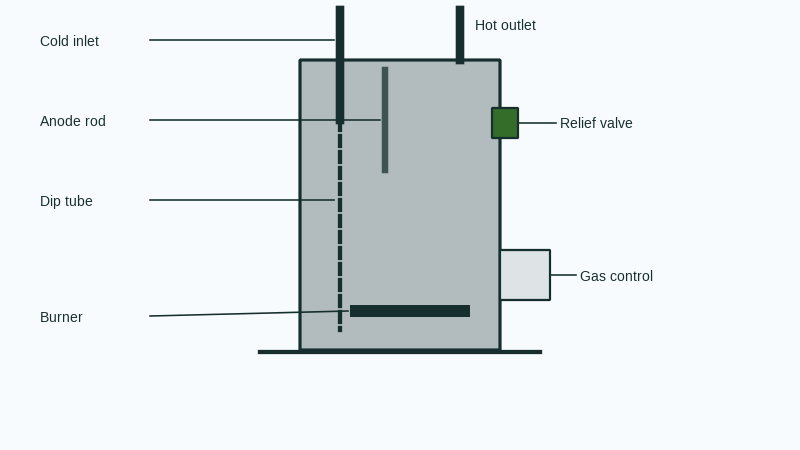
The symptom narrows the culprit before anyone opens a panel. When an electric unit gives no hot water whatsoever, suspect a tripped high-limit reset, a dead thermostat or an element that has burned out. A gas unit that turns cold overnight implicates the pilot assembly, the igniter or a thermocouple that can no longer sense the flame. If the water is only warm and fades quickly, a lower element may have failed, or a broken dip tube is mixing cold into the top.
Tell us the fuel, the make if it is legible on the label and what you have seen. That lets the plumber bring parts that fit instead of guessing on the doorstep.
What happens during a heater repair visit?
The plumber starts with safety, then narrows your symptom down to a single part. First comes the pressure relief valve along with the pipe it drains through, then the gas supply or power, then whichever component the symptom points to. Anything not obviously dead gets tested with a meter or a manometer before it is swapped, so you pay for the real fault.
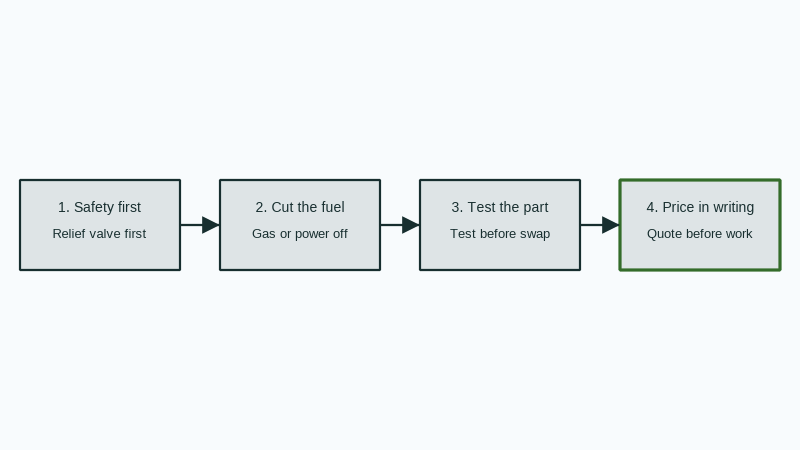
A typical visit to a tract home where the unit stands in the garage goes like this:
- The plumber looks at the floor, the flue and the fittings for moisture or soot.
- Burner, igniter and sensor get inspected on gas; thermostats and elements get a continuity test on electric.
- The tank is checked at the drain valve and the bottom edge for seepage.
- On an older tank, the plumber may mention anode rod wear and sediment.
- You get the price for the whole job before a wrench turns.
Many fixes are finished in one trip, but a gas valve or a tankless control board may need ordering. Pages on thermocouples, replacement elements and relief valves go deeper on the common parts.
At what age should a water heater be retired?
Storage tanks are commonly said to run 10 to 15 years, tankless units about 20. Those are rules of thumb, and local water decides a lot: in hard-water areas, scale accumulates more quickly. Once a tank is past roughly 12 years and shows rust or damp, plan for a swap rather than another repair.
Hardness is worth checking for your own address. The Calleguas Municipal Water District sells wholesale water to the suppliers serving Simi Valley and Moorpark, and each retail supplier issues an annual quality report that lists hardness. Find the report for your supplier (your bill names it) before you decide how hard the tank has been working.
Date the heater from its serial number; manufacturers publish decoding charts. Our notes on the usual replacement interval cover warning signs, and the replacement cost guide explains what shapes the invoice.
What makes a water heater repair cost more or less?
Four things drive the price: the part, the hours, how awkward the unit is to reach, and the time of the visit. We don't print dollar figures we haven't verified. Compare the written total the plumber gives after inspecting the unit, not an hourly rate.
Cheap parts such as an igniter or a thermocouple cost far less than a gas valve or a tankless board. Labor costs more when the heater is squeezed into an attic hatch or hallway closet than when it sits out in a garage. After-hours calls are priced differently by most businesses.
As a rough labor benchmark, federal figures from the Bureau of Labor Statistics show a national median wage of $30.67 hourly for plumbers, pipefitters and steamfitters. A wage is not a bill: the business behind the plumber pays for the van, tools, insurance and permit paperwork. Have parts and labor itemized separately, and hold off on starting until you have approved the number.
Which water heater brands can be repaired?
Nearly all of them. Tanks from Whirlpool, State, Bradford White, Rheem and A. O. Smith share common thermostats, elements, igniters and valves that suppliers stock or can order. Tankless makers such as Navien, Rinnai and Noritz are fussier, with brand-specific fault codes, so each has its own page here.
With a tank, copy the model number off the rating plate onto the form. With a tankless unit, write down whatever error code is showing on the display, because the code often names the cause before anyone arrives.
Brand guides: Navien, Rinnai, Rheem tankless and Noritz. A heat pump water heater adds a compressor and condensate drain above the tank, so mention it on the form. The plumber may bring a different kit.
Can I buy my own heater and have a plumber fit it?
Often, yes, but ask before you buy. Some plumbers decline supplied units, and those who accept may not stand behind the product. A wrong fuel, wrong size or missing vent kit can turn one visit into two, so settle those details first.
Confirm three things. The fuel and venting must match what the house has. The tank must fit the space and the door. And you should ask whether the job needs an expansion tank, new connectors, a drain pan or a new vent, because each adds a line to the invoice.
Swapping a heater usually needs a permit. Simi Valley applicants go to the Building and Safety Division, 2929 Tapo Canyon Road; Moorpark residents use the Building and Safety office at 323 Science Drive. Hours change, so check the city site first. In California a contractor license is generally expected once work totals $1,000 or more, and you can look a license up by number on the Contractors State License Board site.
Is going tankless a big job?
Bigger than a straight tank swap. The burner in a tankless unit is much bigger than the one in a tank, so the gas line often needs upsizing, the venting changes and high-efficiency models need a condensate drain. Plan on a permit and a longer day.
Gas is the sticking point. Many older homes have a half-inch branch sized only for a tank, and the installer sizes the new line from the manufacturer's table for the length of the run. Gas piping belongs to a professional and is no weekend project. Smell gas? Get out of the house before doing anything else. Once outside, contact SoCalGas at 1-800-427-2200, and use 911 for anyone in danger.
Compare what tankless installation costs, the gas tankless guide and tank versus tankless.
Want someone to look at it? Send a water heater request listing the symptom, fuel and your neighborhood, and a nearby plumbing business gets it from us. Requests are read by a person from 9am to 5pm, Monday through Friday. Water spreading now? Start with emergency water heater repair. More about Arroyo Simi Plumbing is on the home page.
Common questions
My heater is leaking, so what now?
Shut the heater's water supply valve, then turn off the electricity or switch the gas control to off. Dripping from a valve or connection can be fixed. Water coming from the tank bottom or through the jacket means a failed tank and a replacement. Mop up quickly, since slab and drywall suffer. See water heater leaks.
Does a tankless heater need larger gas piping?
Often, though the manufacturer's table has the final say, and a 3/4 inch line is a common result. Maximum burner input, run length and every other gas appliance on that branch all count. Old tract homes often have a line too small for a whole-house unit, so upsizing may appear in the quote.
How long will a 20 lb propane tank run a tankless heater?
Not long. A whole-house unit can empty a standard 20 lb cylinder within a handful of hours of showers and laundry, which makes it a poor primary supply. Propane tankless setups use a large tank and regulator sized from the heater's input rating, so check that number first.
Is a 20-year-old heater worth replacing?
Probably, even if it still heats. A tank at 20 is far beyond the usual 10 to 15 year range and can fail while you are away. Look for rust, damp or rumbling, then arrange a quote at a time you choose instead of during a flood.
How long does a swap take?
Replacing a tank with an identical model usually takes a few hours after the new unit arrives. Relocating it, changing fuel, upsizing gas or adding venting stretches that, and an inspection may follow. Request an expected duration alongside the quote, and expect a day without hot water.
What does the anode rod do?
This metal rod sits inside the tank and is built to corrode before the steel wall does, which extends the tank's life. Once the rod is consumed, rust starts attacking the tank. A plumber can inspect it, and a fresh rod can extend an older tank. Details on anode rod replacement.
What makes a pilot flame die repeatedly?
On a gas heater the cause is often a worn thermocouple or a dirty pilot assembly, and on newer models a failed electronic igniter. Never bypass safety parts. Smell gas? Step out of the house and contact SoCalGas away from the building. Otherwise note any blinking code and send it with the form. More on no hot water at all.