An electric water heater that delivers lukewarm water, runs dry fast or trips its breaker probably has a worn heating element, and swapping one is among the easier water heater repairs. It is not for everyone, since you are dealing with household current and a tank of hot water. Here you will learn how to confirm the diagnosis, what the parts are, and the point at which the job belongs with a plumber. Our hub on water heaters covers the wider picture, and we pass requests for the jobs you would rather not do to local plumbing businesses across Simi Valley and Moorpark.
What does a heater element do, and does mine have one?
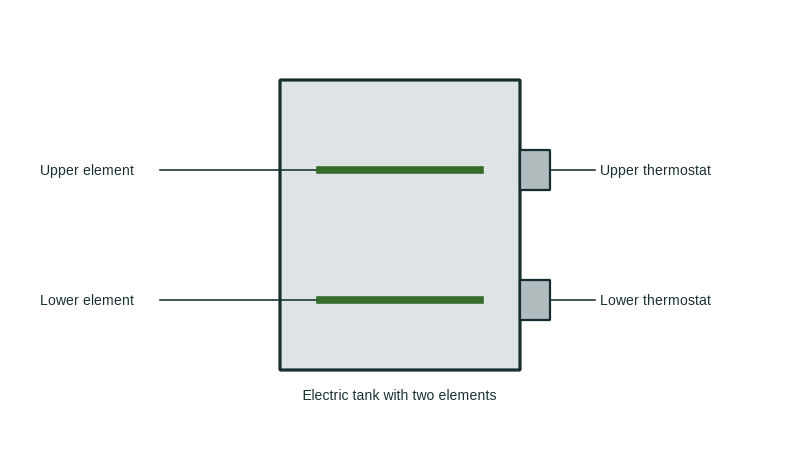
A heating element is a metal rod inside an electric tank water heater that glows hot and warms the water around it. Most tanks hold a pair, one high and one low, each switched by its own thermostat. Gas water heaters and most gas tankless water heaters have no elements, so this page applies only to electric tank units.
Read the label on the heater's side for the voltage and wattage, and look for two small access panels with insulation behind them. Two panels means two elements. If the heater burns gas, with a flue on top and a gas line at the bottom, a different part usually fails when hot water disappears: the thermocouple or the igniter. See the page on a water heater working but giving no hot water to separate the two cases.
What are the steps to change an element on my own?
First turn the breaker off, shut the cold supply and open a hot tap. Empty the tank to below the element, unscrew the old element using an element wrench, then fit the new one together with its gasket. Refill the tank with a hot tap left open until the water flows steadily. Power goes back on last, and never before the tank is full.
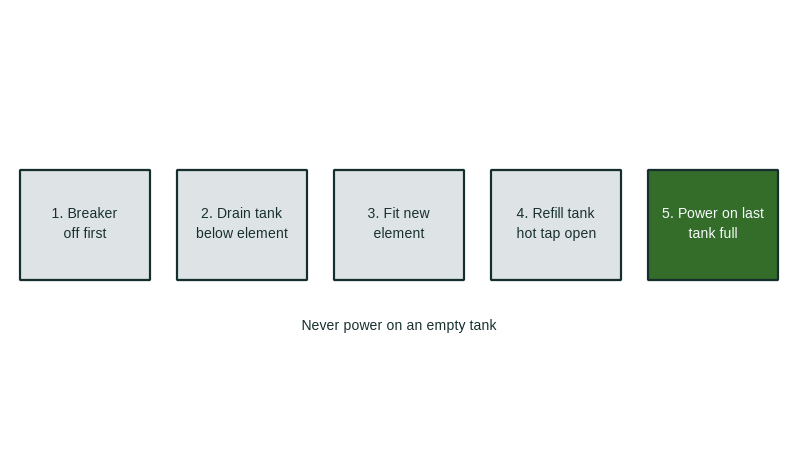
That last rule matters most. An element energized in air burns out in seconds and can start a fire risk. Let the tank fill fully and run a hot faucet until there are no air bursts, then flip the breaker. Check for leaks at the gasket for the first hour.
Scalding is a risk when draining a tank, since the water may be hot enough to injure. Let the heater cool or use heavy hoses and gloves, and route the drain somewhere safe.
If the old element is stuck, the tank is heavily scaled, or water runs rusty, stop; a heavily corroded tank does not justify a new element. See the water heater anode rod page for how corrosion shortens a tank's life.
What separates a dead element from a faulty thermostat?
The symptoms overlap, so test before you buy. Lukewarm water suggests the lower element has failed; hot water that is quickly exhausted points to the lower element or lower thermostat. No hot water at all suggests the upper element, the upper thermostat or the high-limit reset. A multimeter confirms which part is dead.
The test, for someone comfortable doing it:
- Switch off the water heater's breaker at the panel and confirm with a voltage tester that no power reaches the heater. Do not trust the switch alone.
- Remove the access panel and the insulation, and lift the plastic cover.
- With the wires disconnected, set the multimeter to resistance and touch the two element terminals. A good element reads a low, steady number; no reading means the element has burned out.
- Touch one probe to a terminal and the other to the tank metal. Any reading means the element is shorted to ground and must be replaced.
If the element tests good, the thermostat or the high-limit switch is the next suspect, and the reset button above the upper thermostat is worth pressing once. If it keeps tripping, there is a deeper problem and the heater needs a plumber or an electrician.
Which specifications should the new element match?
Match the voltage, wattage and mounting style to the old one. Most household elements are 240 volts, but check the label. The mounting is either a screw-in type or a four-bolt flange, and the length and shape must fit. Buying the wrong wattage can overload a circuit or run the wrong temperature.
Also buy a matching gasket, and consider a low-density element if your water is hard. Hard-water scale builds on the element and shortens its life. No hardness figure has been verified for your address, so check your supplier's yearly water quality report: Ventura County Waterworks District No. 8 and Golden State Water serve Simi Valley, and District No. 1 serves Moorpark. A softener or a regular flush of the tank helps, and the guide on stopping hard water scale goes into detail.
The manual that came with the heater, or the maker's website, gives the exact part number. If the label is unreadable, a plumber or a parts counter can identify it from the model and serial number.
When should a plumber take the job over?
Bring one in if you do not own a multimeter or are uneasy about the electrical side, if the tank is leaking, if the heater is old enough that a new element would be money spent on a tired tank, or if the breaker keeps tripping. Replacing the whole heater needs a permit in California, which means a contractor.
A plumber can swap an element in one visit and check the thermostats during the same trip. Ask for a written quote naming the parts. Contractor licensing in California generally starts at work worth $1,000 and covers any work needing a permit, which includes water heater replacement.
Simi Valley addresses go through the City of Simi Valley Building and Safety Division, and Moorpark addresses through the City of Moorpark's Building and Safety Division, located at City Hall. Confirm hours before visiting. Strapping the tank is part of the rules for a replacement; the plumber will cover it.
If the tank is old, compare a repair against replacement. The factors behind a new heater's price are laid out in the cost guide, and tank and tankless water heaters are compared if you are considering a type change.
Common questions
How long does an element swap usually take?
A plumber can usually finish a single element swap in one to two hours, including draining and refilling. A first-time homeowner should allow a half day, since the tank has to drain and fill. Reheating a full tank takes extra time before hot water returns.
What should I ask a plumber before booking an element job?
Ask for a written quote naming the element and thermostat parts, plus the contractor license number to verify on the state board website. Also find out whether they test the thermostats and the breaker, whether they flush the tank, and which warranty covers the work, in writing.
Must an adult be home for the swap?
Yes, an adult ought to be home to let the plumber reach the heater, shut off the water and verify hot water works before leaving. If the heater is in a garage or closet that needs access, mention it when the plumber contacts you about timing.
Might a faulty element make the breaker trip?
Yes. An element that has shorted to the tank can trip the breaker repeatedly. Do not keep resetting it. Turn the power off and have the heater tested, because a short can also mean a live tank. An electrician or plumber should check it.
How long does a typical element last?
No fixed figure exists; scale, water quality and age decide it. Elements in hard water tend to fail sooner. Flushing the tank each year helps. If your heater has had one element fail and is old, ask the plumber to compare repairing it with replacing it. More in our guides.