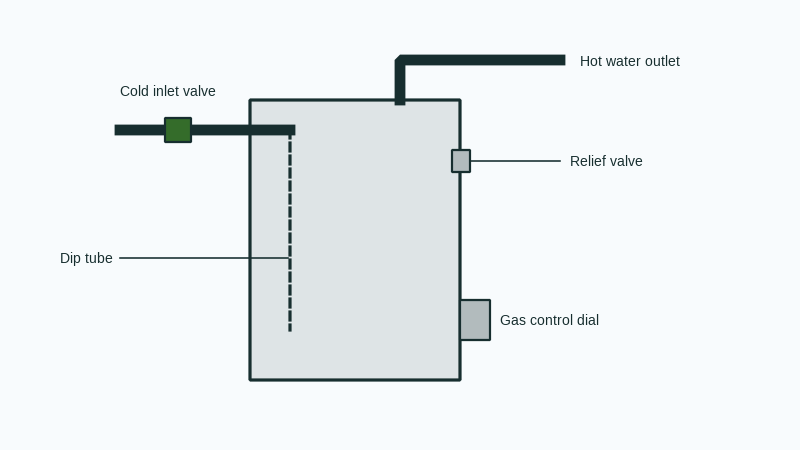
Most water heater trouble is an inconvenience. Only a handful of failures are genuine emergencies: a tank gushing water, a relief valve that discharges nonstop, a gas smell, or scorching water at the tap. The sections below split the two kinds apart, followed by the steps for sending in a request, so a local plumbing business can price water heater repair or replacement.
Is a loss of hot water an emergency?
By itself, a lack of hot water is rarely an emergency in the safety sense. It is pressing for comfort, particularly with small children or an elderly relative at home, but a cold tank is not at risk of causing damage. It becomes an emergency once water is escaping, you smell gas, or the heater runs dangerously hot.
A cold tank usually points to a breaker that tripped, a pilot that went out, a burned-out heating element, a faulty thermocouple or a gas control fault. Check the pilot light and the breaker first. When the unit is quiet, dry and just not heating, request a regular visit on the quote form and mention that hot water has stopped. Our guide on why the house has no hot water ranks the causes by how likely they are.
What counts as a real water heater emergency?
Four situations qualify: water running from the tank or fittings faster than you can mop, a smell of gas around the heater, scalding water at the taps, and a relief valve venting steadily or a tank that hisses and rumbles like a boiling kettle. Any of these can mean flooding, fire or injury, so act first and book afterward.
Pooling at the base may come from a loose fitting, a relief valve that tripped or a tank rusted through. You can tighten a fitting. Corrosion that has eaten through the tank cannot be mended, so the whole heater has to be swapped out. Gas units add the danger of a leak or poor venting, which is why the gas smell gets its own section below. Electric units add shock risk when water sits around a live element.
What do I do right away when a heater fails?
Close the water supply, switch off the fuel, and move everybody clear of the water. Those three steps head off most damage before anyone arrives, and you need nothing more than your hands. Take them in that sequence, and stop if anything feels unsafe, such as water reaching live outlets.
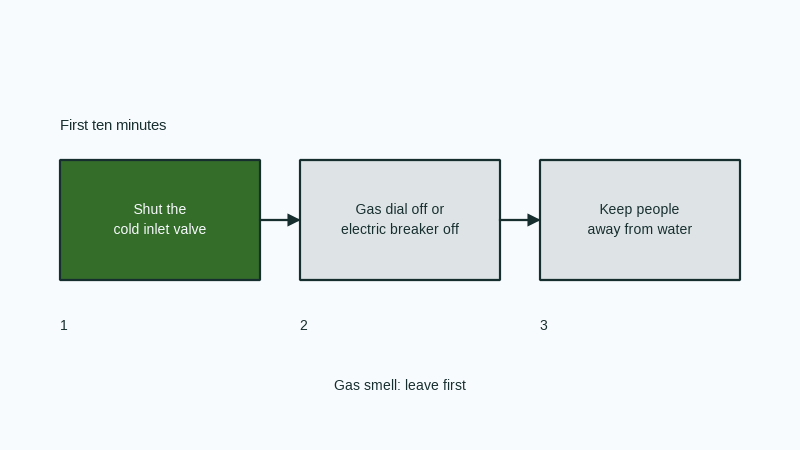
On the pipe above the heater you will find the cold-water inlet valve; turn its handle fully closed. Turn the gas control dial to off, or trip the dedicated breaker when the unit is electric. If water is spreading across the floor toward outlets, stay out of it. Shut off power at the main panel, provided you can reach it without wading. If you cannot locate that valve, the house's main shut-off is your fallback.
When there is a gas smell
Exit the house immediately. Do not touch switches, strike a lighter or open the heater cabinet. Once outdoors, reach your gas utility; 911 is the number if a person is at risk. Gas piping and gas control repairs are contractor work, and a pilot must never be relit in a room that smells of gas.
If water is scalding at the taps
A heater set too high, or a faulty thermostat or mixing valve, can deliver water that burns in seconds. Turn the temperature dial down, warn everyone in the house off the hot taps, and get the thermostat checked. Hold off on bathing a child until it is repaired.
What does a same day repair really mean?
No web page can promise a same-day visit, because that depends on how many local plumbing businesses are free and how far away the job is. We forward your request to local plumbing businesses. The businesses that take requests pay us a fee, and each one decides what it can reach today. A request arriving after hours goes out the next working day.
Everything here runs through the form. Contact happens through the quote form, and someone reads requests on weekdays from 9am to 5pm. We have no round-the-clock line and will not pretend to. If flooding has started inside the home, the first ten minutes described above matter far more than the form. Shut everything off, protect the floor, then send the request with the details below so the plumber turns up with suitable parts.
What details should I put in the request?
Give the plumber enough to quote the job and bring parts. A request reading "water heater leaking, gas, 40 gallon, in the garage, about ten years old, no hot water since morning" gets quoted much faster than "water heater problem", because the plumber can judge the parts and time the visit will probably take.
Say whether it burns gas or runs on electricity, the tank size printed on the data plate, roughly how old it is, where it stands (attic, garage, closet or outdoors), and what you see: dripping, pooling, no heat, noise. Mention if the water is already off. A photo of the data plate and the valves helps if you can attach one, and so does saying whether the plumber can reach you by email during the day.
Is repair or replacement the right call in an emergency?
Replace the unit when the leak comes from the tank body; repair it when a part has failed. A heater whose bottom or seam has rusted is done for. One with a bad element, thermocouple, thermostat, gas valve or relief valve can often be fixed and keep running for years.
Age matters here. A tank approaching a decade that needs an expensive part may be better replaced, since the next failure is probably not far off. Tankless units behave differently: they seldom leak from a tank, but hard water means descaling and parts. The tank and tankless systems comparison covers tankless water heaters and the matching water heater installation work. A replacement normally requires a permit, so ask the plumber who pulls it and what the city building office expects.
What does water damage cost if you wait?
Delay makes a plumbing problem larger, not cheaper. According to U.S. EPA estimates, leaks waste over 9,300 gallons of water per typical home every year, a total that comes from slow drips. A tank that fails outright dumps everything it holds within minutes, onto flooring, drywall and whatever is stored in the garage.
Closing the supply valve costs nothing and limits the damage while you wait for a quote. Take pictures of the leak and the damp areas before cleaning up, in case you need them for a homeowner's claim, and read your policy's wording on sudden discharge. Our insurance and burst pipes page explains how such claims are usually framed.
What are water heaters like in Simi Valley homes?
Many Simi Valley houses are tract homes built between the 1960s and 1990s. The heater typically sits inside the garage, or in a hallway closet, and has been swapped out at least once. Calleguas Municipal Water District supplies the water wholesale, and where it runs hard it coats elements and tank bottoms with scale.
Ventura County Waterworks District No. 8 serves most of the city, with Golden State Water at the eastern end, and your bill names yours. Your own supplier's water quality report lists hardness, so look it up instead of guessing. Scale is the chief reason older tanks turn noisy and tankless units need regular descaling. The City of Simi Valley Building and Safety Division issues replacement permits, and the plumber can confirm the specifics.
Common questions
How much time does an urgent heater fix take?
Minor work such as a thermocouple, element or relief valve typically takes some hours once the plumber arrives with the part. A full replacement often occupies half a day up to a whole day, thanks to draining, venting, gas or electrical hookups and testing. Travel time and parts supply move the total, so the written quote carries the real estimate.
Which questions should I put to a plumber before an urgent heater job?
Get the price in writing before work begins, then ask if it covers the permit, disposal of the old tank, who pulls the permit, and what labor warranty the plumber offers. Confirm the business has a California contractor license, and verify the number on the contractor board website. Compare scope, not only price.
Must an adult be home while the heater work happens?
Normally yes: an adult should meet the plumber on arrival to point out the heater and shut-off valves and approve the quote, then return at the finish to watch it run. If the heater is inside a locked garage or fenced yard, arrange access beforehand. Say in your request if another person will let the plumber in.
Can I keep using the house while the heater is off?
Yes for cold water, cooking and flushing, provided the heater's supply valve is closed and nothing is leaking. Heat water on the stove for washing. Leave the gas control and the breaker off until the plumber gets there. Never restart a heater that has leaked or smelled of gas.