Water dripping through a ceiling, or a toilet that keeps rising, calls for a plan before a price. How much damage the house takes is mostly settled in the opening ten minutes, and nearly all of that work is free: locate the shutoff, stop the flow, move your belongings out of the way. Afterwards a local plumber can be arranged for your Simi Valley or Moorpark address. Every service covered is listed on the Arroyo Simi Plumbing home page. The rest of the page covers those early steps, what rush visits cost, and how to submit a request with the quote form.
How quickly can I get a plumber?
Requests reach us through the quote form or the intake email, and a person goes through them on weekdays from 9am to 5pm. A nearby plumbing business is then asked to reach out to you about timing. We cannot promise arrival times, since those depend on how booked the plumber is and how urgent the problem sounds. If water is running or a drain has backed up, say so plainly in the form.
Some things cannot wait for a form. If water is pouring and you cannot stop it, or you smell gas, act first (the sections below explain how), then send the request. The form suits a leak you have contained, a toilet that is out of action, or a heater that has stopped working, and it suits lining up written quotes. It is not an alarm.
We run no 24/7 line either, so treat with suspicion any website hinting at one while hiding who answers it. Some local plumbing businesses do take after-hours work, and they will say so when they reply.
Which problems qualify as a plumbing emergency?
A true emergency is damage happening to the house now, or a safety hazard, that you cannot stop yourself. Qualifying cases include a gas smell, a pipe that has burst or leaks fast, sewage backing up out of the bathtub or a floor drain, and a total loss of water with a possible main line break. A dripping faucet or a slow drain usually does not qualify.
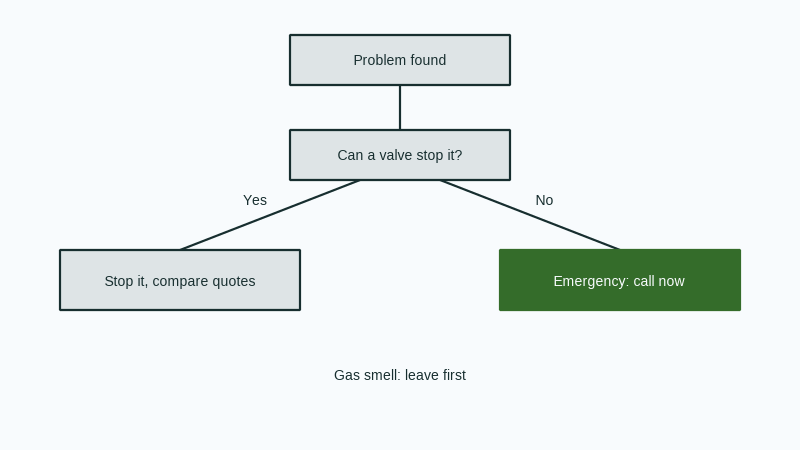
Try this test: if shutting a valve makes the problem stop, it is urgent but no longer an emergency. Close the fixture's stop valve, the water heater supply or the main, and you have gained time to compare quotes rather than pay the top rush rate. When a valve does not help, because the leak sits in the wall upstream of it or the sewer is blocked beyond every fixture, same-day help matters most.
Typical cases in Simi Valley homes include pinhole leaks in older copper, water heaters that fail at the base, hose bibbs and supply lines that split, and main sewer lines clogged where roots get into older clay or iron pipe. Our guides on burst water pipes and emergency water heater repair walk through the two most common ones step by step.
What should happen during the first ten minutes?
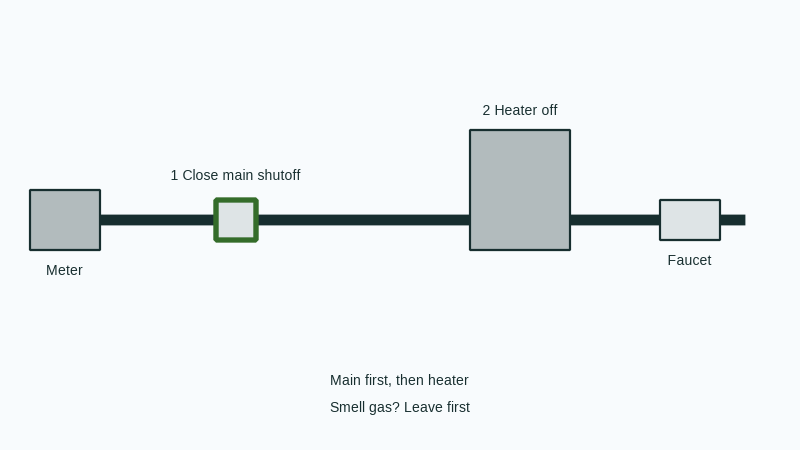
Shut the main water supply, switch off the water heater, and carry belongings out of the soaked area. Houses differ, so locate your shutoff today, before trouble starts. Afterward, run the lowest tap in the house to relieve pressure, and take photos of the damage before you start cleaning.
This sequence suits most homes:
- Close the main shutoff valve. In many Simi Valley homes it sits on the front wall near the hose bib, or inside the meter box beside the street. A quarter-turn ball valve closes with a lever; an older gate valve takes several clockwise turns.
- Shut down the water heater. For a gas model, rotate the gas control to its pilot or off position. For an electric model, trip the breaker first, since an element that keeps running in a drained tank burns out.
- Keep away from switches, outlets and appliances while you are wet-footed or water is nearby. Switch off the power at the panel only if your hands and feet are completely dry and the panel is within safe reach.
- Take photos of everything, then mop and set up fans. Your insurer will ask for the record; what to document is spelled out on our insurance and burst pipes page.
Smell gas? Do not hunt for where it comes from. Get everyone out, leave the lights alone, and once you are in a safe spot outside, report it to SoCalGas at 1-800-427-2200. Call 911 too if you feel in danger.
How much is a typical call out fee?
A call out fee covers the cost of getting a plumber to your address, and many take it off the final repair price if you go ahead. Amounts and rules differ between businesses, and rush or after-hours visits cost extra. No figure is printed here because none has been verified. Before the visit, ask every business to put in writing its hourly rate, its call out fee, and whether it deducts that fee.
Emergency visits follow the same pattern. Expect three parts: a call out or diagnostic fee, labor charged by the hour or the job, and parts. Weekends, nights and holidays often add a surcharge, so containing the problem and booking for the next working day tends to cost less. Do not allow work to begin without a written quote, and find out how the price shifts should the plumber discover another problem behind the open wall.
California law limits any deposit to $1,000 or 10 percent of what the contract says you will pay, whichever is less, so be cautious of anyone demanding a large payment up front. Details are on the contractor board's site, linked in the sources below.
What credentials should a plumber hold in California?
Any plumbing job costing $1,000 or more in labor and materials requires a California contractor license, and so does smaller work that needs a permit. The Contractors State License Board issues these licenses, and you can look up a license number on cslb.ca.gov before work starts. We do not employ plumbers ourselves; each business your request is passed to answers for its own work, so ask each one for its license number.
Always check two things yourself: the license status and classification, and whether the business carries workers' compensation insurance if it has employees. Get the license number in writing, then verify it with the board. Ask to see proof of insurance rather than accepting a verbal yes.
The threshold matters for small jobs. Under the board's rule, some small work under the dollar line is allowed without a contractor license, but a permit is normally required for gas piping, replacing a water heater, or any main line job, and with it comes the contractor license. Do not let anyone talk you out of the permit.
How can I pick a good plumber?
Choose a business that provides a written quote, shows a license number you can verify, explains its findings before starting, and does not push you. Read recent reviews for how problems were handled, not only the star counts. A good plumber separates what is urgent from what can wait.
Some questions to ask: Who is coming, and what is the license number? Is the quote fixed or hourly? How big is the call out fee? Which permit does the work need, and who applies for it? What warranty comes with the work, in writing? The answers say more than any website.
Here is how the form works: your request is sent to nearby plumbing businesses, and we receive a fee from each business that takes requests. You compare what comes back. Nothing is bought or booked until you accept a specific quote.
When is weak water pressure worth a visit?
Weak pressure at every fixture together points to the main, the regulator or the supplier, and merits a visit within days. A weak flow at just one fixture is typically a blocked aerator or cartridge, which you can often clear yourself. A sudden drop plus a damp patch in the yard or an unexplained high bill signals a leak.
With every fixture switched off, read the water meter. A dial that keeps moving shows water escaping somewhere. Most of Simi Valley is served by Ventura County Waterworks District No. 8, with the eastern end on Golden State Water, so your bill shows who to ask about supply-side problems. For the regulator and the checks in detail, read the guide on low water pressure.
Is there such a thing as the 135 rule in plumbing?
That phrase did not trace back to any single official rule within the California Plumbing Code, so we are not speculating about what it means. People sometimes use it loosely for 135 degree drain fittings or water temperature limits, and the meaning shifts with the speaker. Should a plumber bring it up, ask which code section they have in mind.
Questions to settle before the visit
Have these ready: the address, what you saw and when it began, where your main shutoff is, whether it is closed yet, how old the house is, the water heater's age if you know it, plus photos. If a permit may be needed, the issuing office is Moorpark's Building and Safety counter at City Hall or Simi Valley's Building and Safety Division, depending on your address; confirm hours before going.
Common questions
Do plumbers deal with water pipes?
Yes. Water supply lines, shutoff valves, fixtures, water heaters, and the drains and sewer lines that carry waste away are all plumbing work. Depending on the home's age, supply pipes may be copper or PEX while drains are plastic or cast iron. Gas piping is regulated separately and calls for a contractor and usually a permit.
What hourly rate is fair for a plumber?
The rate shifts with the business, the type of work and the time you call, and rush visits cost more. We have no verified figure to quote. Get the hourly rate and call out fee in writing, then compare them with one flat price covering everything. Our page on plumber hourly cost explains how rates are built.
What marks out a dependable plumber?
Confirm the contractor license number through the state licensing board, ask for a written quote that itemizes labor and parts, and steer clear of anyone asking for a big deposit. California limits deposits to $1,000 or 10 percent of the job total, whichever is smaller. Get permits and warranty terms in writing, and compare at least two quotes when the job is not urgent.
How much water might a minor leak lose?
According to EPA estimates, a typical household leaks more than 9,300 gallons a year. Usual causes are a slow drip or a toilet running on after a flush, and the loss appears as a higher bill. If the meter dial moves while all fixtures are off, track down the leak before it turns into an emergency.
Are weekend requests accepted?
You can submit the form whenever you like, but requests are read from 9am until 5pm on weekdays. A nearby plumbing business replies about timing, and some take weekend work at a higher rate. For active flooding, close the main first rather than waiting for a reply. Browse the guides to understand the job before quotes arrive.