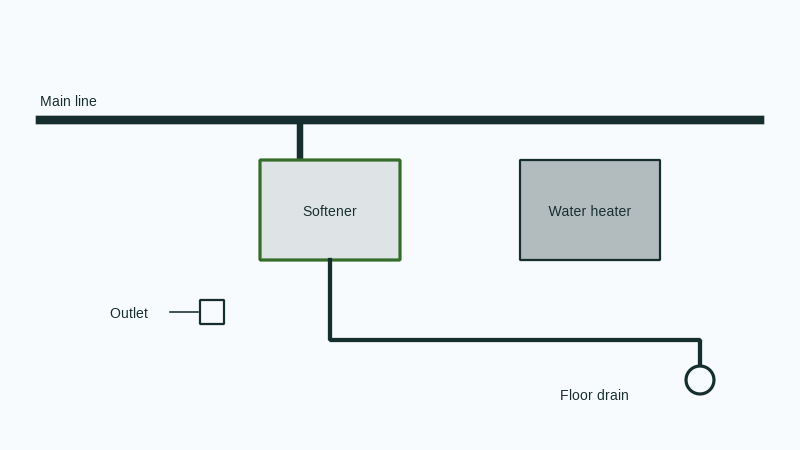
Installing a softener costs the unit plus the labor and materials needed to connect it to your supply, drain and power. Dollar figures we cannot source are not published, so this page sets out the drivers and the questions to ask. A local plumbing business gives the real price once it sees your layout. You can begin on the home page or go directly to the quote form.
Which items add up to a softener installation bill?
A typical quote itemizes the softener (tank, resin and control head), a bypass valve set, copper, PEX or flexible connectors, a drain line fitted with an air gap, an electrical outlet or timer connection, and the plumber's time. Whether you purchase the unit or the plumber provides it moves the total more than anything else.
If you buy the softener from a big-box store or a dealer, the plumber quotes labor and parts only. If the plumber provides it, the quote bundles equipment, delivery and set-up, and warranty terms follow the equipment maker. Ask whether the quote says "installed" or "labor only" so two quotes compare like for like.
What does a softener loop add to the cost?
A softener loop is the set of pipes, valves and a bypass that lets the softener be connected or removed without cutting into the house plumbing again. Building a new loop adds labor and materials to the quote. If a builder has already stubbed one out, usually near the garage or side of the house, connecting is far simpler.
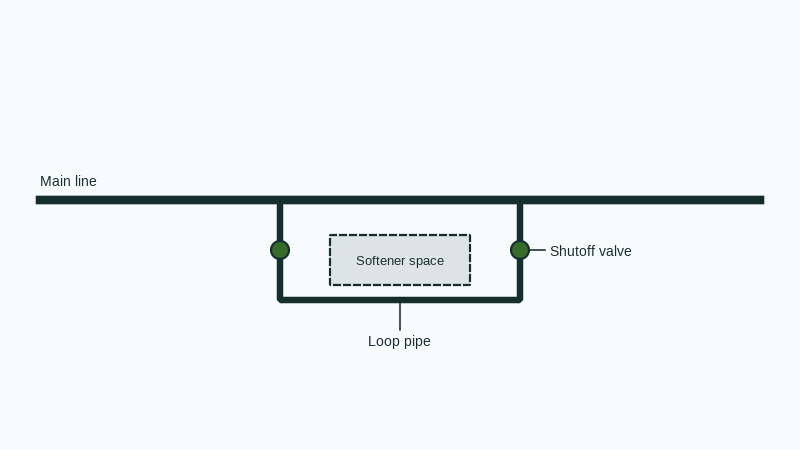
Some tract homes have a softener loop capped in the garage or on an exterior wall, although how common that is locally has not been verified. Have the plumber look for it. If you see two short capped pipes next to the main line, with a valve between them, mention that in your request.
How does labor compare with the cost of the unit?
Labor turns on how far the softener sits from the main line, how many fittings the plumber needs, and whether new pipe, a new drain connection or a new outlet is required. A softener beside an existing water heater and floor drain is a short job. A long run through a finished garage wall is not.
Plumbers in this region usually bill by the hour, by the job or at a flat fee for a standard install. Ask which model the quote follows, and what happens if the plumber finds a problem, such as a seized valve or galvanized pipe that crumbles when cut. A fixed price should state what is excluded.
Does a softener need a permit?
It depends on what the job touches. Adding a softener to existing plumbing is often treated lightly, but new drain connections, gas, or electrical work can bring a permit requirement. Your city decides, so have the plumber check with Simi Valley Building and Safety, or Moorpark Building and Safety, before work.
Work above the state threshold, and any job requiring a permit, needs a California contractor license. You can check the plumber's license number on the CSLB website. Deposits on California home improvement work are capped by law, so be wary of anyone asking for a large sum up front.
What raises or lowers the total?
Six things move the total: layout and distance from the main line, pipe material at the connection, the make and size of the softener, whether a loop already exists, drain access, and whether the job needs a permit or other work like a pressure regulator or a new shutoff valve.
| Factor | Pushes price up | Keeps price down |
|---|---|---|
| Distance to main line | Long run, finished walls | Next to the water heater |
| Pipe material | Galvanized, brittle or mixed | Copper or PEX in good condition |
| Loop in place | No loop, plumber has to build one | Loop already stubbed out |
| Drain | No nearby drain, long run to a standpipe | Floor drain or laundry standpipe close |
| Electrical | Outlet must be added | Outlet within reach |
| Unit | Large capacity, branded dealer model | Small household unit |
| Extra work | New shutoff, regulator, permit | None |
What should a good softener quote contain?
A good quote names the model and capacity, lists every part and connection, states the drain method, says whether the permit is included, explains what happens to any old unit being replaced, and gives the schedule. It should also say who owns the warranty on the equipment and on the labor.
Get it in writing, and have the plumber note any problem found at the main line so you can see what changed from the original quote. Collect two or three quotes, and compare each line instead of only the bottom number.
Does the brand or dealer change what installation costs?
The brand mostly changes the equipment price, not the plumbing labor. Manufacturers sell different sizes and control types, and dealer-supplied units often bundle the install. Labor tends to be similar across brands unless a model needs a special connection.
When you are offered a package, check what the equipment warranty covers and who handles service. Some dealer packages require their own technicians for warranty claims, so a quote from an independent plumber may not carry the same service arrangement. Ask who to turn to when the unit needs resin or a valve change.
Is hard water in Simi Valley and Moorpark enough to justify the expense?
That turns on how hard your tap water is, and no hardness figure is quoted here because a current number for your supplier has not been confirmed. Read the latest annual water quality report from your provider, or ask the plumber to test a sample at your faucet.
Ventura County Waterworks District No. 8 serves most of Simi Valley and Golden State Water serves the eastern end, with Calleguas Municipal Water District supplying both wholesale. Ventura County Waterworks District No. 1 serves Moorpark. Your bill says which one is yours. The guide to removing hard water scale shows the signs on fixtures and appliances, and water softener installation covers how the visit runs.
One point to weigh: a softener does not reduce your water bill, and a plumber should not claim it does. The page on whether a softener can raise your water bill explains the regeneration water.
Common questions
Is a loop required before a softener goes in?
Not always, but a loop makes the job simpler and cheaper to repeat later. Without one, the plumber builds a loop as part of the job, which adds fittings and labor. Look near the main line in the garage for two capped stubs, and mention them in your request.
Is it realistic to put in a softener on my own?
In many cases you can, and some owners make the connections when pipe and drain are simple. The risks are leaks inside walls, cross-connecting the bypass wrongly, and voiding a dealer warranty. If the job touches gas, electrical or main-line plumbing, or needs a permit, it belongs to a contractor.
What is the usual installation time?
A standard installation with a loop and a nearby drain is generally finished within a few hours on site, including testing and programming. New piping, a long run or other repairs add time. The plumber can give a better window after seeing the location.
What should I ask an installer before hiring one?
Ask whether the price covers equipment and labor, what permit and drain work is included, which contractor license number applies, whether old pipe may need replacing, and who will service the unit afterward. Have the answers written on the quote, with a start date.