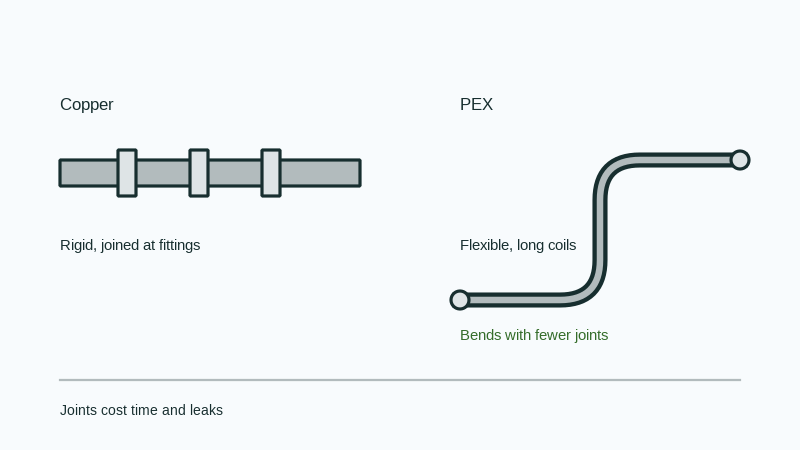
Neither material wins every time. Copper is the long-proven metal and handles heat, sunlight and fire better. PEX costs less to install, turns corners with fewer joints and survives a hard freeze better. In most Simi Valley houses a full house repipe in PEX comes in under copper, although copper still makes sense for exposed runs and for owners who like a material with decades of history. Below: cost, flow, lifespan, cold weather, connections and questions for a plumber.
Which is cheaper, PEX or copper?
PEX usually costs less, both for the tubing and for labor. It comes in long coils that curve around framing, so a plumber makes far fewer joints than with stiff copper, and every soldered joint eats time. Copper is also pricier per foot, with a price that follows the metal market. Exact dollar figures differ by house, so get both quoted in writing.
We publish no per-foot or whole-house number, because none was verified for Simi Valley. Quotes also depend on the number of bathrooms, wall access, whether a slab is involved, and how much drywall repair is included. Pricing the full job? The repipe cost breakdown shows what a whole-house job involves, and each line of the written quote can be compared against it.
How does flow differ between the two at half-inch and three-quarter-inch sizes?
On the inside, copper is slightly wider than PEX with the same nominal size, so a half-inch copper line carries a little more water than half-inch PEX. In a house the difference rarely shows at the faucet. Long runs, many fixtures in use together, and fittings that narrow the bore matter more than the material.
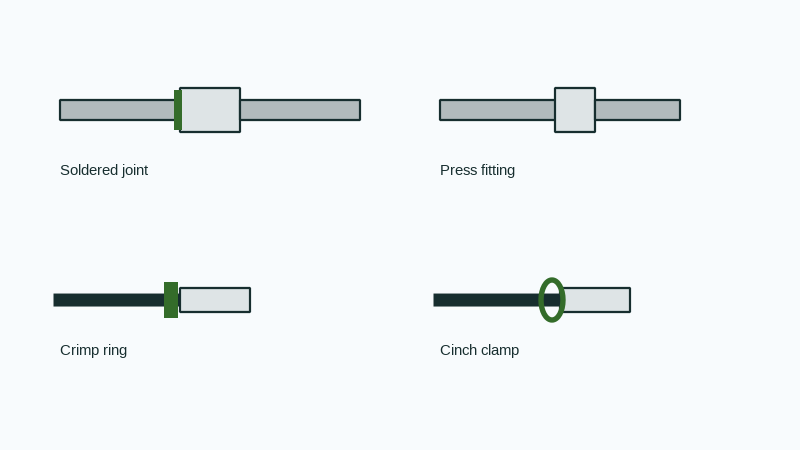
PEX connections deserve attention. Crimp rings and cinch clamps on standard fittings pinch the passage a bit at each joint, and a manifold with one line to each fixture can make up for it. When sizing a repipe for a family running two showers at once, a plumber will often step up to three-quarter-inch trunk lines with either material. If weak pressure is your real complaint, read about low water pressure before blaming the pipe.
Which one lasts longer?
Copper has the longer history, measured in decades inside walls, while PEX has been common in American homes for a shorter time. Neither expires on a set date. Copper fails through water chemistry, pinholes and corroded fittings. PEX fails through sunlight, damaged fittings, chemicals and poor installation. Most lifespan claims online come from manufacturers, so treat them as rough guidance only.
Local water quality affects copper. Water in Simi Valley and Moorpark arrives through Calleguas Municipal Water District and your own supplier, and the yearly report from that supplier is where you check hardness and chemistry before choosing. A pinhole leak in copper is a classic late-life sign, and the stop-gap appears in our guide to repairing pinhole leaks in copper. When several show up, a repipe is usually the better answer, as covered in how often to repipe a house.
Which handles cold weather better?
PEX handles freezing better. The tube can expand a little when the water inside turns to ice, so it splits less readily than rigid copper, though fittings can still fail. Hard freezes are rare in a mild climate like ours, but exposed lines on an unusually cold night still deserve protection.
Whichever you choose, insulate exposed lines in a crawl space, garage or exterior wall. Foam around a pipe slows heat loss; it will not stop a hard freeze. In sunlight PEX is the weaker choice: keep it out of direct UV and cover any section exposed outdoors or behind a window. Copper has no such limit, so some plumbers use it for the exposed section by the meter or water heater, with PEX inside the walls.
How are PEX and copper joined?
Copper is soldered with a torch or connected with press fittings. PEX goes together with crimp rings, stainless steel cinch clamps or expansion fittings from makers such as Uponor, and each system needs its own tool. The plumber must use the fitting type approved by the tubing maker. Mixing brands of tube and fitting is a frequent source of leaks.
Brass fittings handle transitions between PEX and copper, and they should stay reachable, not buried. When the water heater is replaced during the same work, find out how the plumber will tie in the hot and cold lines. Older metal lines need a different approach, which our note on galvanized pipe replacement covers, while polybutylene replacement deals with an older plastic line that some homes of that era may still have.
Is either one safe for drinking water?
Both are widely used for drinking water. Look for the potable water marking printed on the tube, which shows approval for that use. Copper can leach into water that sits in the pipe if the water is aggressive, and brand-new PEX can give water a faint taste in the first weeks. After a repipe, let the taps run several minutes.
If you have a health concern about either material, ask the plumber for the manufacturer's data sheet and your supplier for its annual report. For Simi Valley the supplier is Ventura County Waterworks District No. 8 or Golden State Water, and for Moorpark Ventura County Waterworks District No. 1; your bill says which.
Is a permit or contractor license required for a repipe?
California requires a contractor license for any job that hits $1,000 in labor and materials combined. A whole-house repipe passes that figure and normally calls for a permit plus an inspection. In Simi Valley, permits are handled by the Building and Safety Division of the city; in Moorpark, by that city's Building and Safety office.
Check with the city before hiring. Ask the plumber for a contractor license number, then verify it on the CSLB website. Office hours and contact details are on each city's own page. Never hand over a deposit larger than the smaller of $1,000 or 10 percent of the contract price.
How should I compare plumbers' quotes?
From each plumber, request the material, the line sizes and the fitting type. Ask who obtains the permit and what workmanship warranty the plumber's business offers, plus how many access holes will be cut and who patches the drywall and paint afterward. Ask each for the same scope, and for PEX and copper options on one quote.
A fair comparison also names the plan for the old pipe, the window when the water is off, and what happens at the water heater connections. If one quote is far lower, find out what it omits. Our guide to repiping a house lists the steps in order, and the reasons people repipe help you judge whether your house needs it now. The rest of the work we arrange is listed on the Arroyo Simi Plumbing home page.
Common questions
Does PEX cost less than copper?
In most houses, yes. PEX tubing is cheaper per foot and installs with fewer joints and less labor, which is where the bulk of the saving lies. Prices shift with house layout, wall access and permit costs, so request both materials on a written quote and compare line by line.
Is PEX suitable outside or underground?
Sunlight degrades PEX, so it should never sit exposed outdoors. Buried runs need approved tube, sleeves where the line crosses concrete or runs beneath slabs, and fittings kept above ground when possible. Follow the manufacturer's instructions and the plumber's advice for your lot, because rules vary by product and location.
Are PEX leaks more common than copper leaks?
Leaks usually begin at fittings rather than in the tube. A correct crimp or clamp should last many years, and poor ones show up early. Copper leaks tend to arrive late, from pinholes or aged solder joints. Ask who made the fittings, who installed them, and whether pressure was tested before the walls were closed.
What suits a mobile home?
PEX is the usual pick for plumbing beneath a mobile home floor. It flexes, copes with the movement of a manufactured home, and installs easily in cramped crawl spaces. Shield it from sun and keep the crawl space insulated. Our guide to plumbing under a mobile home has more.