What is an instant water heater, and why does it break down?
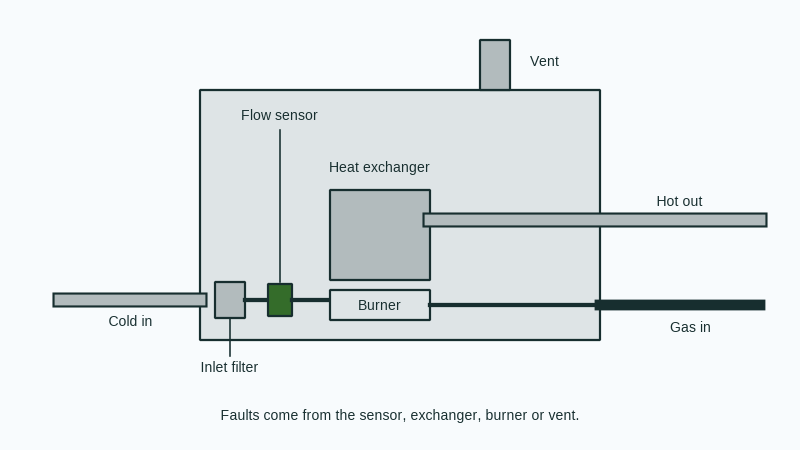
This type, sold as tankless or on-demand, keeps no reserve of hot water. When you open a hot tap, a flow sensor signals a gas burner or electric elements to start, and the water warms on its way through. Failures come from the sensor, heat exchanger, burner, vent or control board. For the wider picture, see the water heater services overview.
Because everything happens in seconds, even small faults get noticed quickly. Mineral buildup inside the exchanger, a grimy inlet filter, weak flow, a blocked flue or a gas line that falls short each produce the same complaint: water that is too cold, too hot or erratic.
Some people use the phrase for a compact electric unit under the sink. These work on a similar principle but are simpler, and a dead one frequently costs less to swap than to fix.
Why is my instant water heater giving lukewarm or cold water?
Typical causes are weak flow, mineral buildup, a clogged filter or a unit too small for the load. If the water goes cold only when two taps run together, the heater may be maxed out. If the problem never lets up, look at the inlet filter and supply valves first, since a half-closed valve starves the unit.
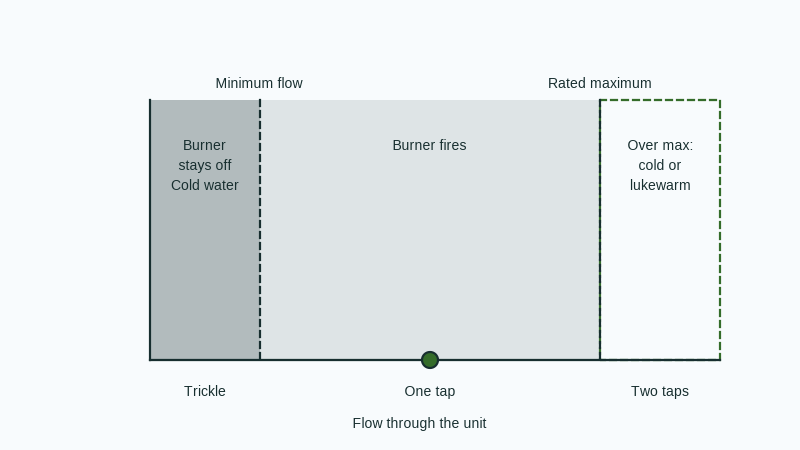
Run a single tap on hot at a moderate stream. A trickle can keep the sensor from lighting the burner, so you get cold water although the heater is healthy. A faucet aerator choked with grit does the same, so unscrew it and rinse it clean.
Once supply and tap flow look normal, scale becomes the prime suspect. Hard water lines the exchanger and cuts its output. Hard water scale prevention covers how it forms and how to slow it. Your water supplier's annual quality report lists hardness, and we have no local figure to give you.
How do I make sense of the error codes?
Each manufacturer uses its own code list, printed in the manual or on a label on the unit. Typical meanings are an ignition failure, no flame, overheating, a venting fault, a flow fault, a blocked condensate drain or a faulty sensor. Note the code, turn the unit off, then on again, and if it returns, treat it as a real fault.
Never keep resetting a heater that shows a gas, flame or vent code again and again. Repeated ignition attempts against a blocked flue or thin gas supply can be hazardous. Look the code up in the manual, record it and quote it when you ask for help.
Fuller coverage of the best known makes is on the brand pages: Navien, Rinnai, Rheem and Noritz. Match the code on your display to the right page.
Which checks are safe to do on your own?
Safe checks include confirming power is on, the gas and water valves are fully open, the temperature setting is reasonable, the display is free of codes and a tap runs normally. You may also rinse the inlet screen if the manual explains how, after switching off water and power.
Leave the front cover on, and do not work on the burner, open the gas line or change the vent. Gas appliances are regulated work, so anything past the owner-level steps in the manual is for a plumber or appliance technician.
If gas is ever smelled, leave the building and reach the gas utility's emergency line from outdoors; use 911 if you feel in danger. Do not try to relight or reset the heater.
What does flushing and descaling do?
Flushing circulates a mild acid, typically white vinegar or a solution the maker approves, through the exchanger so that scale dissolves. That brings back heat transfer and flow. Most makers give the method and the schedule in the manual, and many models have service ports built for it.
An owner who is at ease closing valves and attaching hoses can flush a heater, though mistakes are easy. Shutting the wrong valve, running the pump dry or forgetting to reopen the isolation valves are the usual slips. If unsure, have a plumber do the first flush with you looking on.
Where water is hard, the first flush often reveals how much scale has accumulated, and it sets how often to repeat. Write down the date. A written record helps if you ever make a warranty claim.
At what point is repair no longer worthwhile?
A repair is reasonable when the failure is a sensor, a filter, a thermistor, a flow valve or a vent issue and the heater is young enough to justify the spend. Replace it if the exchanger has failed or leaks, the heater is nearing its end of life or parts approach the cost of a new one.
Ask for both a repair figure and a replacement figure at once. A plumber who offers only one leaves you deciding blind. What a swap involves is laid out on the tankless replacement cost page.
Water dripping from the unit, soaked insulation or a stain under the heater means you should shut the water at the unit and arrange help rather than keep running it. Treat an exhaust smell, soot around the flue or a carbon monoxide alarm the same way.
How do you request instant water heater repair in Simi Valley or Moorpark?
Submit the quote form listing the brand, model, error code, fuel type, how old the unit is and anything you already tried. A photo of the data plate and the display is the biggest help. We pass it to a nearby plumbing company, and companies that accept requests pay us a fee. Requests are read on weekdays between 9am and 5pm.
Mention whether the heater is outdoors, in a garage, a closet or an attic, because access shapes the job. Tenants should say so and let the owner know before work starts. Once you are set, request a quote from Arroyo Simi Plumbing.
To see why newer houses favor tankless units, and how they stack up against a tank, read our tank versus tankless guide.
Common questions
How long does an instant water heater repair take?
Cleaning a filter or replacing a sensor can finish within an hour. Burner, fan, circuit board or exchanger work runs longer and may involve ordering parts. Once the fault is diagnosed, the plumber should tell you if the fix fits into the same visit.
Why does my instant water heater turn cold with two taps open?
Every tankless model has a flow ceiling for a given temperature rise, and two taps can pass it. Count how many fixtures draw water together and compare to the unit's rated flow. At times nothing is wrong and the cure is staggering showers, but an undersized unit may need replacing or a second heater.
Would a lower-flow showerhead stop the cold bursts?
It can help. The EPA says standard showerheads draw up to 2.5 gallons per minute, while WaterSense models draw 2.0 or less. Lower flow lets a tankless unit keep pace and hold a steady temperature. Pick a model with a good spray so showers still feel right.
What should I ask a repair business before anything else?
Find out if they service your brand, what the diagnosis fee is and whether it comes off the repair, which warranty applies to parts and labor, and how they deal with gas and venting. Verify the contractor license number with the state board, and get the scope written down.