A Rinnai tankless water heater that quits usually explains itself: the controller displays a code, the unit fires then shuts off, or the water never warms. Record the code, check the gas valve and power, and look the code up in your manual. Because gas, vent and burner repairs need a contractor, treat this page as a map. It belongs to our broader guide to water heater repairs.
How do I read a Rinnai error code?
Every code points at a system the unit monitors: ignition, flame, venting, water flow, temperature or electronics. The owner's manual and the label inside the front cover give the meaning, and the number matters more than the wording. Note the code and the model before anything else, because a reset can erase the clue.
A reliable list of every code is not possible here, since models differ and the maker's manual has the final word. What the codes tend to indicate:
- Ignition or flame problems. The burner will not light or goes out. Causes include a closed gas supply, an air bubble after gas work, a flame rod coated with dirt or a failing igniter.
- Venting or air supply. The unit cannot exhale or inhale. A blocked flue, a bird nest or a crushed vent pipe trips it.
- Water flow or sensor faults. Low flow, a clogged inlet filter, or mineral buildup in the exchanger.
- Overheat or temperature faults. Often scale again, or a failing thermistor.
- Condensate faults on condensing models, when the drain is blocked.
If the manual offers a reset, try one. Should the same code return, stop and describe it. Repeated resets on a gas appliance are unwise.
Which Rinnai repairs belong to a contractor?
Anything touching the gas valve, burner, gas pipe, venting, main circuit board, heat exchanger or a sealed part is contractor work. Gas piping and appliance connections often call for a permit and inspection. Involve a plumber when codes keep returning, when you smell exhaust, or when the unit leaks.
Warning signs that mean stop and get help:
- Water pooling beneath the unit.
- Black soot marks around the vent or unit.
- A smell of gas, or any carbon monoxide alarm.
- A unit that clicks and does not light after you have checked power and gas.
- A heat exchanger that leaks or makes a boiling noise.
Paid plumbing work above a small threshold generally requires a California contractor license, which you can verify on the CSLB website. When you send a quote request, list the model number, the fault code and your earlier checks. The request goes through us to a local plumbing business, and those businesses pay us a fee for the requests they accept.
If the repair price comes close to what a new unit costs, request both options on paper. The pages on tankless replacement cost and Rinnai tankless installation help with the comparison. For other brands, see Navien repair, Noritz repair and Rheem repair.
Which checks come first before I ask for a visit?
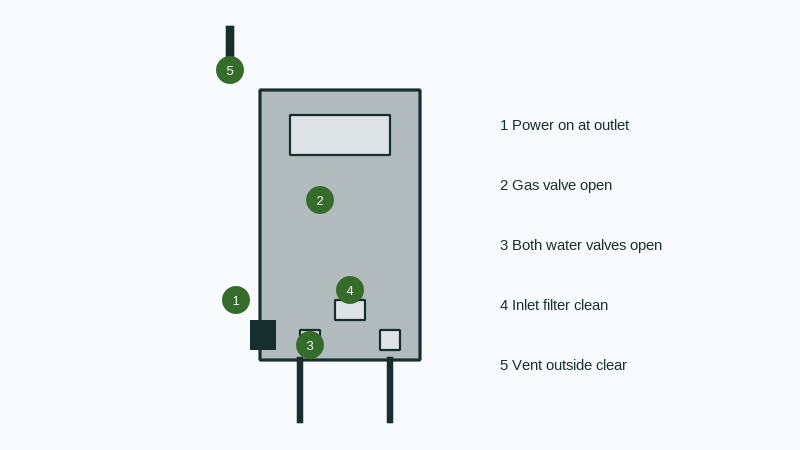
Check that gas reaches the unit through an open valve, power is on, the water supply valves are open, and the inlet filter is clean. Make sure nothing is stored against the unit and the vent outside is clear. Many no-hot-water complaints turn out to be a shut valve or a tripped breaker. Work through these in order before booking anyone.
A short checklist:
- Power. Is the unit plugged in, and is the outlet or breaker live?
- Gas. With the valve open, its handle lies parallel to the pipe. Never touch the gas pipe itself.
- Water. Both isolation valves should be open. A partly closed valve produces low flow and lukewarm water.
- Filter. Close the water, then rinse the inlet screen when the manual shows the method.
- Another tap. If just one tap runs cold, a mixing valve or faucet may be at fault, not the heater. See the page on no hot water at the kitchen sink.
- Display. Record the code and the date.
If gas is ever in the air, leave switches alone. Exit the building, then contact your gas utility from outside (the number is on your bill), and use 911 if anyone is in danger.
What causes lukewarm output or sudden cold bursts on a Rinnai?
Lukewarm water generally means mineral scale in the exchanger, a blocked inlet filter, a partly closed valve, or flow below the minimum that fires the unit. Cold bursts occur when a tap is opened only slightly, so flow is too low to light the burner, and when two fixtures draw hot water together.
Possible causes:
- Scale. Hard water leaves deposits inside the unit that restrict flow and insulate the heat exchanger. Your district's yearly water quality report gives the hardness. Ventura County Waterworks District No. 8 serves most of Simi Valley, Golden State Water serves the eastern end, and Ventura County Waterworks District No. 1 serves Moorpark.
- Crossed connections. A faulty mixing valve or a crossover leak in a fixture sends cold water into the hot side.
- Minimum flow. A low-flow aerator or a half-open tap can fall below what the unit needs.
- Undersized unit. If the house grew or a bathroom was added, the heater may be at its limit.
ENERGY STAR lists 2.8 gallons per minute at a 67 degree rise as a minimum for gas tankless models, which shows why running several fixtures together can push a unit to its ceiling.
What extends the life of a Rinnai tankless unit?
Flush it as often as the manual says, clean the inlet filter, keep the vent and surroundings clear, and avoid long periods at low flow. In hard water, regular descaling helps most of all. A plumber can also check combustion and vent condition during a yearly visit.
A basic maintenance routine:
- Check the controller for stored codes once a year.
- Keep the space around the unit free of boxes and cleaning supplies.
- Inspect the vent terminal outside for nests, leaves and damage.
- Test the pressure relief valve if your model has one.
- Note the age of the unit. ENERGY STAR criteria show a six year heat exchanger warranty as a minimum, which hints at how long makers expect them to run, but the real lifespan depends on water and use.
Is flushing and descaling a Rinnai a DIY task?
Many owners manage it by following the maker's directions. It takes a small pump, two hoses, isolation valves on the unit and a descaling solution as the manual directs. A unit lacking isolation valves needs a plumber to fit them first. Flushing will not fix a faulty part, but it is a common maintenance step.
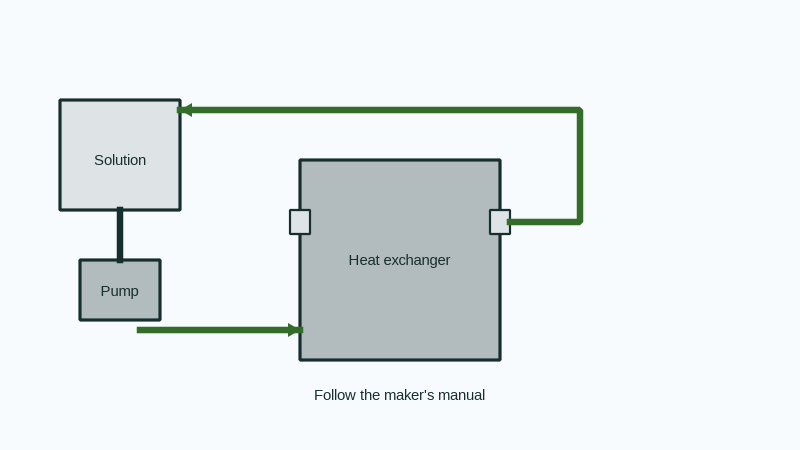
An outline of a flush, subject to your model's manual:
- Switch off power and gas to the unit.
- Close the isolation valves and open the service ports.
- Connect hoses and the pump so solution circulates through the heat exchanger.
- Run it for the time the manual gives, then rinse with clean water.
- Clean the inlet filter, close the service ports and reopen the valves.
- Restore power and gas and check for leaks.
Flushing will not cure a unit with a failing component. If the code returns after a clean flush, the fault lies elsewhere.
Common questions
How long does a Rinnai repair take?
A flush, filter clean or valve fix often runs one to two hours. An igniter or sensor swap can be finished in a single visit when the plumber has the part on the truck. If a part has to be ordered, a second visit follows. The plumber should mention that at the first visit.
What should I ask a plumber before a Rinnai repair?
Ask if the visit fee is credited to the repair, whether the plumber works on your model, and what the parts warranty is. Get a written quote ahead of the work, and check the contractor license on the CSLB site. Keep the model number and code ready.
Does the manufacturer warranty cover the repair?
It may, provided the unit is within warranty and was installed correctly. Check the warranty papers and the registration. Warranty usually covers parts and sometimes not labor. Ask the plumber what can be claimed, and keep the receipts and the installation invoice.
Should an aging Rinnai be fixed or swapped out?
A young unit with a minor fault is worth repairing. An old, scaled unit needing a major part calls for comparing the repair quote with a replacement. Request both on paper. The right choice depends on age, parts price and how well the unit has been maintained.