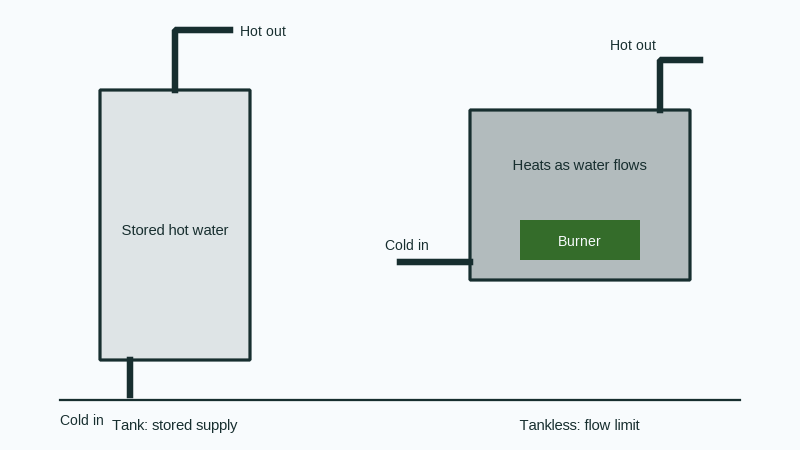
Pick a tank water heater if you want the simplest swap and your hot water use is steady. Pick tankless if you have wall space and a gas line that can feed it, and you are tired of running cold during back-to-back showers. Neither wins everywhere. The answer depends on your pipes, your vent route and how many people want hot water together.
This page sits under the broader water heater repair and replacement guide. It walks through a plumber's reasoning, then shows what to put in a quote request.
Which suits my house better, a tank or tankless unit?
Settle it by checking three facts at your own house: where the heater stands today, which fuel it burns, and your hot water demand during the busiest hour of the day. A tank suits a straight replacement. Tankless suits a home with room on a wall and a gas supply or electrical panel that can carry it.
A storage tank keeps about 40 to 50 gallons hot around the clock, so the first shower is easy and the third may run cold. A tankless unit has no stored supply to drain, but it has a flow ceiling. When the shower, dishwasher and a laundry load all ask for hot water at once, the unit can reach that ceiling and the temperature drops.
Ask yourself these questions while you walk through the house:
- Does the present heater sit in a garage closet, a hallway cupboard or an attic? Tankless units hang on walls and need a vent path, so the location matters more than the model.
- Does it burn gas or run on electricity now? Switching fuel adds pipework or wiring.
- How many bathrooms are there, and how many people use them within the same hour?
- Will you stay five years or more? Tankless units cost more at the start and repay slowly.
Houses in the Simi Valley tract areas built from the 1960s to 1990s often have the heater in the garage, which makes a tank swap simple and a move to tankless possible. Older small lots in Old Town Simi can have tight closets that limit both options.
What do tankless heaters offer over a tank?
The main advantages are no reserve to run out, a smaller footprint, and in many homes a lower energy bill. The drawbacks are a higher purchase and installation price, a flow limit, and more components that can fail. Whether the gains justify those costs depends on your hot water habits.
Ratings help you judge efficiency. ENERGY STAR sets a minimum Uniform Energy Factor (UEF) of 0.95 for gas tankless units. For gas storage tanks of 20 to 55 gallons its minimum is 0.81 for medium use and 0.86 for high use. A higher UEF means less fuel per gallon of hot water. Those are minimums, not the rating of every model sold, so read the label on the actual unit.
More points compared in a table:
| Question | Tank heater | Tankless heater |
|---|---|---|
| Can hot water run out? | Yes, once the stored volume is used | No, but flow has a ceiling |
| Wall or floor space | Floor standing, bulky | Wall mounted, compact |
| Warranty example from ENERGY STAR | Six years on a gas storage system | Six years on the heat exchanger, five on parts |
| Venting and gas line | Usually reuses what exists | Often needs fresh venting and a bigger gas pipe |
| Maintenance | Anode rod and flushing | Periodic descaling, which matters with hard water |
ENERGY STAR also expects a gas tankless unit to deliver at least 2.8 gallons per minute over a 67 degree rise. That is a floor for the rating, not a promise about your house. One shower head plus a kitchen tap can draw more.
Is a gas or electric tankless unit better than a tank?
Gas tankless units normally win on output, since gas supplies more heat per hour than a household circuit. Electric tankless units can be tidy where there is no gas, but they pull a heavy electrical load and often require a panel upgrade. Compare each with a tank on the same fuel, not with the other fuel.
On gas, the issue is the gas line. A tankless burner uses far more gas per hour than a tank burner, so pipe sized for a tank may be too small. A plumber must check the pipe size and run, and gas piping work is for a contractor only. Should you smell gas, exit the building, then reach your gas utility from outdoors (the emergency number is on your bill), and use 911 if a person is in danger.
On electric, have an electrician or plumber check the panel and the circuit before you buy. A heat pump storage heater is another electric option. ENERGY STAR lists a minimum UEF of 3.30 for integrated heat pump units, but they need open air around them and are a tank design, so they belong on the tank side of this comparison.
A propane tankless unit exists for homes that burn propane instead of natural gas, but the burner, orifice and regulator must match the fuel. Name the fuel when you send your request so the quote covers the correct model.
What is a mini tank, and does it beat tankless?
Think of a mini tank as a compact storage heater, holding a few gallons and mounted under a sink to serve one fixture. It does not replace a whole-house heater. It suits a distant bathroom or a kitchen tap where the long wait for hot water is the complaint.
A tankless unit feeds the entire house through one set of pipes. A mini tank only helps the tap next to it. If the trouble is a lengthy pipe route from the main heater to a faraway bathroom, a small unit near that bathroom can solve it for less than changing the whole system. It does need an electrical outlet and is one more item to maintain.
How can I estimate savings before switching?
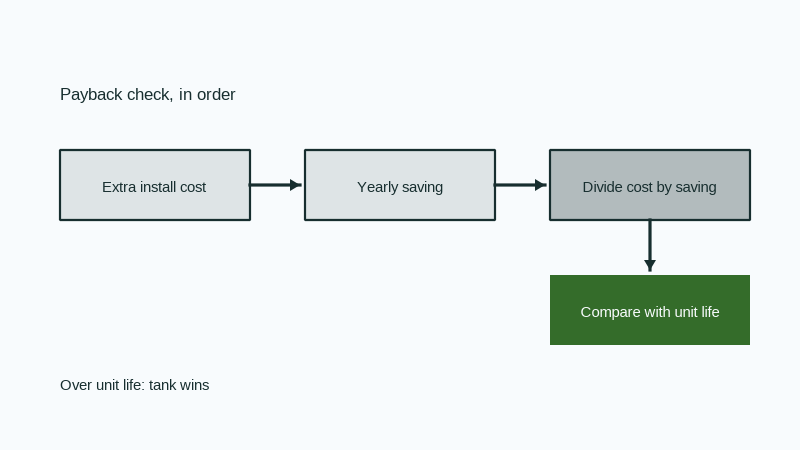
Take the extra upfront cost of the tankless option, set it against the annual saving, then divide. Ask for both options in writing, together with your last year of gas or electric bills. A rough payback figure only means something if the quote itemizes every extra: vent, gas line, permit, any condensate drain, and removal of the old unit.
No single calculator is right, and older comparisons, such as those written around 2016, often rely on a different rating. If a web article quotes an Energy Factor, treat it as dated and look for the UEF on the current label. Use this simple method:
- Write down the yearly cost of the current heater from your bills, if gas or electric is billed separately from heating.
- Find the UEF of the model on the quote in the manufacturer's literature.
- The saving is not the whole UEF difference. Standby loss is only part of a bill, so a modest saving is more realistic than a dramatic one.
- Divide the extra install cost by the yearly saving. If the result is longer than the life you expect from the unit, a tank wins on money.
Where the water is hard, add descaling visits to the tankless column. Check hardness in your supplier's yearly water quality report: most of Simi Valley is on Ventura County Waterworks District No. 8, the eastern end is on Golden State Water, and the bill tells you which one you have.
What drives the cost when choosing tank or tankless?
The price of a switch comes less from the appliance than from the work around it. Venting, gas line size, electrical changes, wall repairs and the permit all move the quote. A tank swapped for a tank has few of those extras, which is why it is usually the cheaper job.
Have the written quote show each of these lines:
- The unit itself, brand, model and UEF.
- Gas pipe changes, or electrical panel and circuit work.
- Venting or flue, and where it exits the wall or roof.
- Expansion tank, which is frequently needed on a closed water system.
- Pressure relief valve and discharge pipe.
- Permit through the city building office, plus hauling away the old heater.
Permit filings go to the city building office: City of Simi Valley Building & Safety Division for Simi Valley, and City of Moorpark Building & Safety for Moorpark. Check current hours on the city site before planning around them. California also expects whoever does contracting work to hold a contractor license; before accepting a quote, you can check one on the CSLB site.
Can a tankless heater be repaired, and by whom?
Yes, most faults are repairable: error codes from a blocked vent or scale, ignition problems, sensors and flow faults. Descaling is a common cure in hard water areas. Repairs to the gas valve, burner and venting are contractor work. Flushing the unit and cleaning the inlet filter are jobs a careful homeowner may do with the manual.
When the unit shows an error code, record it, note the model on the data plate, and say whether you get no hot water, only warm water or the unit switching on and off. That helps the plumber bring the correct part. Our water heater repair guide deals with the tank side, and brand pages such as the one on Rinnai tankless repair explain common codes.
Common questions
How much of the day does installing a heater use up?
A tank replacement usually takes about half a day when access is easy. Moving to tankless often takes a day or longer, since the vent, gas line and mounting are all new. The plumber should write the expected time on the quote, and a city inspection can add a separate visit afterward.
Which questions are worth asking an installer before I hire?
Insist on a written quote naming the unit, the vent and gas work, the permit, and disposal of the old heater. Ask who obtains the permit, and verify the contractor's license through the CSLB site. Learn what the manufacturer warranty covers and who handles a claim if the unit fails early.
Does someone have to be at the house for the installation?
Yes, an adult should be present to admit the plumber, point out the heater and sign off on the work. Water, and sometimes gas, goes off for a stretch of the day, so plan showers around the visit. If you cannot be home, send a trusted adult instead and let the plumber know beforehand.
Does a tankless heater reduce the bill?
It can, mainly by cutting the heat lost from a stored tank. How much you save depends on your hot water use, and it may be modest in a small household. Compare the UEF on the labels and get both options in writing before deciding.