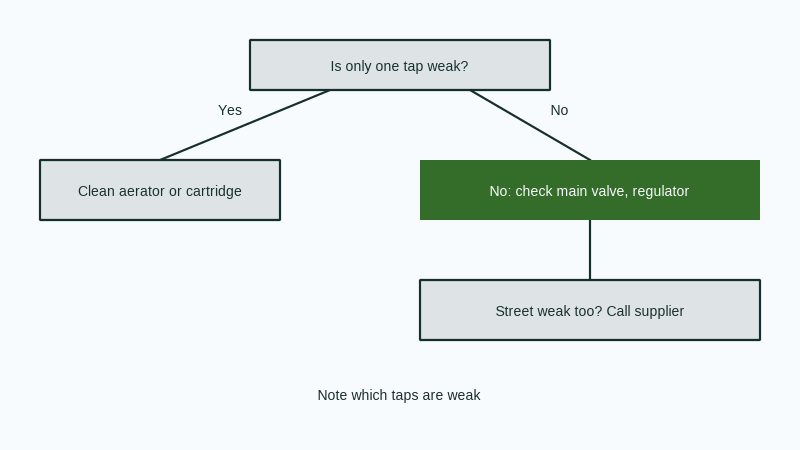
When the shower shrinks to a trickle overnight, a set routine beats guessing. These steps follow a plumber's logic: whole house or one tap, indoors only, the supplier's role, and whether a well or cold weather matters. A full guide to pressure problems and remedies is on the water pressure and valves page. For the other kinds of work we pass to local plumbers in Simi Valley and Moorpark, see the home page.
Why does household water pressure drop without warning?
A sudden drop usually comes down to one cause: a partly closed valve, a failed pressure regulator, a leak, trouble in the supplier's main, or a blocked fixture. Ask neighbors if they notice the same, inspect the main valve, and test every tap. The pattern shows whether to look at the house, the supply or one fixture.
Consider what changed recently. Plumbing or street work, a shut-off valve turned and not fully reopened, a new filter or softener, or a newly connected appliance can each explain a sudden shift. Gradual causes such as scale rarely create an overnight drop. The USGS explains that scale accumulates over long periods, narrowing pipes, cutting flow and lowering pressure, so suspect it when pressure has crept down, not when it fell overnight.
Jot down what you observe: which taps, hot or cold, morning or evening, and whether the sound changed. Nothing helps a plumber more than that list.
Does freezing weather lower the pressure indoors?
Cold can cut flow when water freezes in a pipe, mostly in an exposed or uninsulated run. After a hard freeze, one weak line may mean a frozen section, and a burst can follow at thaw. Leave the tap open slightly, warm the pipe gradually, and close the main if water appears.
Never thaw a pipe with an open flame. Warm towels or a hair dryer are safer. Insulate exposed pipes in garages, crawl spaces and outside walls, and cover outdoor taps. The guide on burst pipe prevention lists the steps.
Cold weather may also make an existing fault easier to notice, since colder incoming water exposes a weak water heater or a marginal valve. If the weakness appears only with hot water in winter, have a plumber inspect the heater.
Why do indoor taps run weak while the outdoor tap is fine?
Good pressure at an outdoor tap alongside weak flow inside means the supply is working, and the restriction sits in the house piping or a device attached to it. Suspect a regulator that is wearing out, a valve left partly shut, scale or corrosion narrowing old pipe, or a clogged filter or softener.
An outdoor tap may hide the restriction, since it can sit on another branch with fewer fixtures, shorter pipe and a separate valve. A freely running outdoor tap does not prove the street supply is fine, but it gives a useful clue.
Inspect any filter housing first, because a clogged cartridge is an easy fix. With a softener, look at its bypass. Old galvanized steel pipe often causes weak flow indoors, as it corrodes inside over the years, and the page on galvanized pipe replacement explains the signs. An inexpensive hardware-store gauge screwed onto an outdoor tap gives you a number to hand the plumber.
What if the house is on a well and the pressure drops suddenly?
A house on a private well runs its own pressure tank and pump, so a sudden drop often means a failed pressure switch, a waterlogged tank, a tired pump or a falling water level. Some rural and canyon properties near Simi Valley and Moorpark may use wells; if yours does, check the gauge and the pump breaker first.
A gauge needle that jumps quickly, or a pump that clicks on and off every few seconds, suggests a waterlogged tank. A pump that runs yet delivers no pressure may have lost its prime, or the well level may have fallen. These jobs call for a pump or well specialist as well as a plumber, and you should say you are on a well when you book.
Unsure whether you have a well or a supplier's main? Your water bill or the meter box will answer: a house on a supplier has a meter and a bill, and a house on a well has neither.
Is every tap weak, or just one?
Test the taps one by one. One weak fixture signals a local problem: a half-closed stop valve, a tired cartridge, or a clogged aerator or showerhead. Weak flow at all taps points to the main valve, the pressure regulator, the supplier and hidden leaks. Weakness on hot alone points toward the water heater or its valves.
At a single tap, unscrew the aerator, check for grit, and run the water without it. On a shower, soak the head in vinegar or replace it. Separate guides treat a feeble kitchen tap and low pressure in the shower.
If just hot is weak, inspect the shut-off valve above the water heater and any filter on the line. Read about the heater end under low hot water pressure. A failing dip tube inside the heater or a half-closed valve are frequent culprits, and a plumber can check both.
Could the supplier, a main valve or a regulator be the cause?
If neighbors are affected too, start with the supplier. Ventura County Waterworks District No. 8 serves most of Simi Valley, Golden State Water serves the eastern end, and Ventura County Waterworks District No. 1 serves Moorpark, so rely on the name printed on your bill. A main break, flushing or maintenance can reduce pressure along a street for a time.
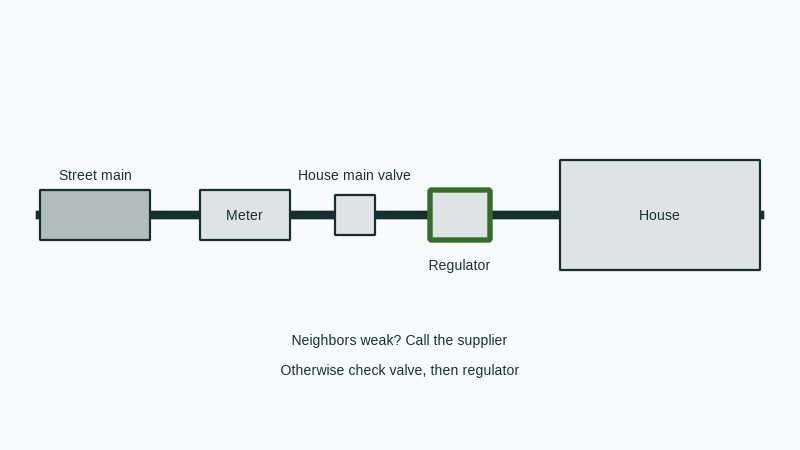
When the street is fine, look at the house main valve and the meter valve. The commonest cheap cause is a valve that was only partly reopened after plumbing work, and opening it all the way may fix things instantly. Open it slowly so the pipes do not hammer; if banging follows, see water hammer sound.
Many houses have a pressure regulator where the supply comes in. A failed one can let pressure fall, or sometimes spike. Pages on finding the regulator, a whole-house regulator and regulator replacement explain how to locate it and when to replace it.
A concealed leak can also steal pressure. Per the EPA, a family of four using over 12,000 gallons a month may have serious leaks, so check the meter with everything off, and if it moves, read about the reasons a water bill jumps.
Who is the right contact when pressure drops suddenly?
Start with the water supplier if neighbors have weak pressure or the whole street is affected. If only your property is hit, book a local plumber, who can inspect the regulator, main valve, supply line and hidden leaks. Mention which taps are weak and when it started.
Fill out the quote form with the symptoms, the house's age and anything already checked. Your request is forwarded to a nearby plumbing business; after that a plumber comes to look and puts the quote in writing before work begins. The form is checked Monday to Friday, 9am to 5pm. When water is spraying or flooding, shut the main first instead of waiting for a reply.
Common questions
How much time is needed to track down the pressure fault?
Inspecting the main valve, regulator and fixtures may need only a short visit, while hidden leaks or old pipes take longer to trace. The plumber will offer a time estimate on the day. No response times are promised on requests sent through the form.
Which questions come before booking help for a pressure problem?
Ask whether the visit includes a gauge test, what happens if the supplier or an old pipe is to blame, and whether a regulator or valve replacement is priced on its own. Get the price on paper, and look up the contractor's license number with the California Contractors State License Board.
Does weak pressure on hot only mean a heater fault?
Often it does. A valve left half shut at the heater, a blocked dip tube or sediment can reduce hot flow while cold runs normally. If hot and cold are both weak at a given tap, the supply, regulator or fixture itself is the likelier cause.
Should someone be at the house during the pressure check?
Yes, an adult ought to be there to point the plumber to the main valve, the regulator and the weak taps, and to agree on what gets checked. Make a note of any recent plumbing or street work before the visit, since it can point to the cause.