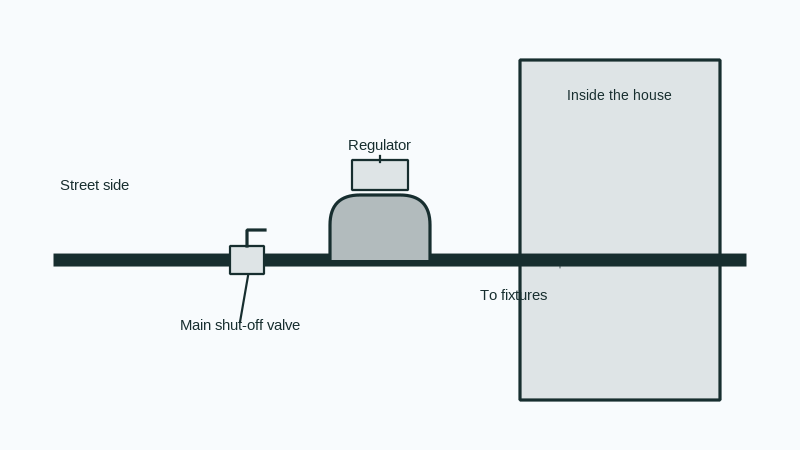
The main regulator is a bell-shaped valve fitted on the pipe right where the supply comes into your house. It steps the street's pressure down to a steadier, gentler level for your pipes, taps and appliances. When it wears out, you may see low pressure, high pressure, banging pipes or leaks. This page belongs to our low water pressure guide.
What is the main regulator for?
It reduces and holds the pressure of incoming water so that fixtures, hoses and water heaters are spared the full force of the street supply. Inside, a spring and diaphragm open and close the valve to keep the outlet at a set level, even as the supply side rises and falls.
Water reaches your property at whatever pressure the supplier runs. Lots at the foot of a hill usually see higher pressure, and lots up high see lower. A regulator evens out what the house receives. Without one, pressure can climb enough to loosen fittings, wear out washing machine hoses and water heaters sooner, and make pipes bang.
Not every home has one. Some older houses were built without it, and some regulators were removed or failed without notice. Where a regulator exists, it is a working part that wears out over time.
Where is the regulator on the main line?
Start at the spot where the main water line comes into the house, which is often beside the main shut-off valve. Likely spots include a garage wall, a side yard by the meter box, a crawl space entry or a utility closet. It is a brass, bell-shaped body about the size of a grapefruit, set into the pipe.
How to find it:
- Begin with the main shut-off valve; the regulator normally sits just past it, on the house side.
- Look for a bell-shaped fitting with an adjusting screw and a locknut on top.
- In some homes it sits in an underground box in the front yard, near the meter.
- If you find nothing, there may not be one.
The pages on where it is located and what it looks like offer more help. Attach a photo to your quote request so whoever takes the job can see what is installed.
What are the signs of a regulator on its way out?
Expect high pressure with sudden surges, weak pressure that nothing else explains, banging or humming pipes, dripping relief valves, and fixture leaks. A gauge threaded onto a hose bib gives a number that settles things; a reading that climbs overnight is a classic sign of failure.
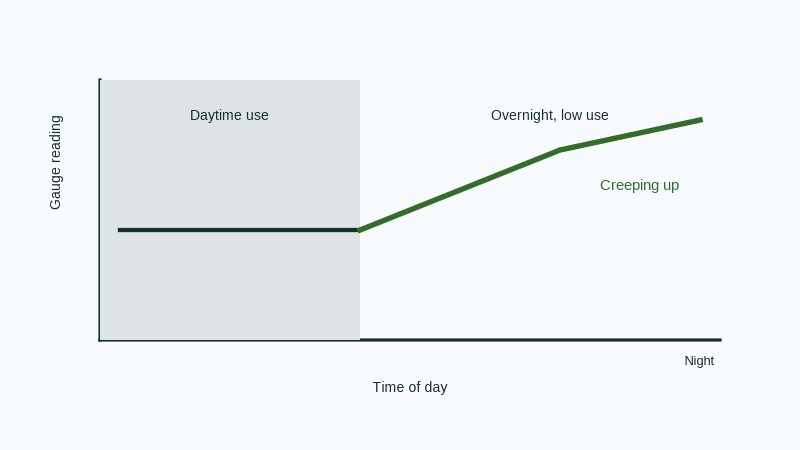
Symptoms by type:
- Pressure too high. Toilets run or hiss, faucets spit, hoses burst, the relief valve on the water heater drips.
- Pressure too low. Weak showers throughout the house although the street pressure is fine.
- Pressure creep. Pressure looks fine by day and climbs at night when use drops.
- Noise. Whining at the regulator or banging as taps shut. See water hammer sound.
- Leaks. Water around the regulator body.
A gauge that screws onto a hose bib is cheap and reports static pressure. Read it while every tap is off, then read it again at night. If the number is far above what the manufacturer or code allows for your fixtures, have a plumber examine the regulator.
Other faults can produce the same symptoms. The page on sudden low water pressure covers the other causes, like a valve partly shut or a leak.
Is it safe to adjust the regulator on my own?
Many regulators have an adjusting screw under a locknut, and a careful owner can change the setting while watching a gauge on a hose bib. Loosen the locknut, then turn the screw in small increments, letting the gauge settle each time, and retighten the locknut at the end. Do not guess: rely on the gauge and small steps.
In practice:
- Thread the gauge onto an outdoor hose bib and close every tap.
- Note the static pressure.
- Loosen the locknut; turn the screw clockwise for more pressure, counterclockwise for less.
- Open a tap to bleed off pressure, close it, and read again.
- Tighten the locknut.
If a regulator will not hold its setting, creeps upward or leaks, replace it, since adjusting will not help. Keep in mind that fitting a regulator can close off the plumbing, leaving heated water no room to expand. Where that happens, you will often need an expansion tank. See expansion tank replacement.
Each of the Ventura County Waterworks Districts and Golden State Water runs its own supply pressure. Most of Simi Valley is on Ventura County Waterworks District No. 8, the eastern end is on Golden State Water, and Moorpark is on Ventura County Waterworks District No. 1. Your provider's customer office can tell you the pressure to expect on your street.
What does replacing a main regulator involve?
The plumber starts by shutting the main and emptying the pipe. The old regulator is then cut out or unscrewed at its unions, and one of the same size and type goes in. Water returns gradually and a gauge guides the pressure setting. The new regulator must match the pipe diameter, so size counts. With easy access the job usually takes a few hours.
What shapes the work:
- Pipe size. Three quarter inch and one inch are common, and the regulator must fit the line. See 3/4 inch regulators and 1 inch regulators.
- Union fittings. Regulators with unions come out fast. One soldered into copper takes longer.
- Access. A buried or cramped spot adds time.
- Main shut-off valve. If it will not fully close, it may need replacing first.
- Expansion tank. Often installed at the same visit.
For the swap itself, see water pressure regulator replacement and whole house regulators. If picking a model is the hurdle, the home regulator buying guide lists what to compare.
Should I install a regulator when pressure feels fine?
Often yes if you have never taken a gauge reading, because high pressure is not always noticeable until something fails. A reading settles it. If pressure sits in a normal range for your fixtures, you may not need a regulator, but a high reading means a regulator protects pipes and appliances and can cut leaks and water waste.
High pressure speeds the flow at every tap and strains seals. EPA identifies leaks as a common cause of wasted water in homes and recommends checking your meter after two hours of no use. A regulator is one way to prevent leaks that begin with high pressure. A dripping fixture is another: EPA reports that a fixture dripping once each second wastes more than 3,000 gallons over twelve months.
Should the gauge show a normal number and the house stay quiet, nothing needs changing. Write down the reading so you can compare it next year.
When should a plumber look at the regulator?
Bring one in if the gauge shows high pressure, the regulator leaks, pressure rises overnight, the pipes bang, or the relief valve on the water heater drips. A plumber can test, adjust, replace and add an expansion tank if required. The work touches the main line, so it is not a casual job.
When you send a quote request, we hand it on to a local plumbing business, and the ones that take requests pay us a fee. Include a gauge reading if you took one, the location of the main shut-off and a photo of what is installed. Paid plumbing work in California above a small threshold requires a contractor license, which you can check on the CSLB website. Also ask whether a permit applies, and confirm with City of Simi Valley Building & Safety Division or City of Moorpark Building & Safety.
Common questions
How much time does swapping a pressure regulator need?
Typically two to three hours when the main shut-off works and access is easy. A soldered regulator, a buried one or a faulty main valve adds time. The plumber should state an expected time on the quote, along with any extra work found.
Which questions come first before a regulator is replaced?
See whether the quote lists the gauge test, the pressure setting, a new shut-off valve if the old one is faulty, and an expansion tank where one is needed. Verify the plumber's contractor license on the CSLB website, and have the quote written out, naming the regulator size and connection type.
Does a regulator lower the water bill?
It can, by cutting leaks and tap flow when pressure runs high. The effect varies by household, so do not expect a large saving. The real benefit is protecting pipes, hoses and the water heater from stress. A steady gauge reading after the swap shows the regulator is working.
Is a main regulator standard in every home?
No. Some homes have none, and some have regulators that have failed. Look near the main shut-off, or check the street side for a box. If you cannot find one, a pressure gauge reading will show whether you need one.