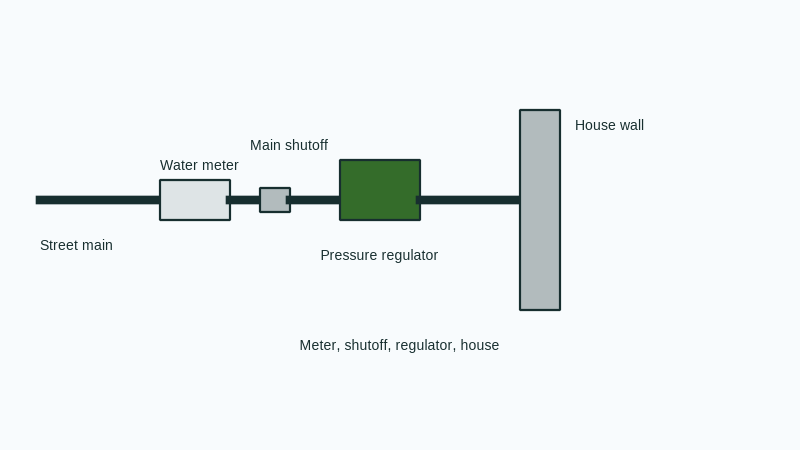
The house-wide pressure valve is normally installed on the incoming supply line, downstream of the main shutoff and close to where that line enters the building. Depending on the property, it may be in the garage, a utility closet, a crawlspace, a basement, a pit beside the meter or against an outside wall. Below is where to look, and our overview of water pressure and valves covers the rest.
Where does a pressure regulator usually sit?
Check the supply pipe, a few feet beyond the point of entry and immediately after the main shutoff. In many homes that means the garage wall nearest the street, the spot around the water heater, an outdoor utility box, or a crawlspace under the front of the house.
Water arrives from the street, passes the meter, then the main shutoff and, if one is installed, the regulator. Start at the meter box or where the pipe leaves the ground and follow it toward the house. Some lines disappear into a concrete slab and come up again in the garage or a hall closet. Where two shutoffs exist, one at the meter and one at the house, the regulator generally sits downstream of the house shutoff.
Is it safe to adjust or replace it on your own?
Some models can be tuned by turning the screw in small increments and rechecking the gauge, but replacing one means cutting into the supply pipe, work that often calls for a permit. State rules generally call for a contractor license on any job needing a permit, and on any job priced at $1,000 or more.
The City of Simi Valley Building and Safety Division and the City of Moorpark's Building and Safety office decide when this work needs a permit. If gas smells anywhere near the work area, leave the building and contact your gas utility or 911 from outside. If you try an adjustment, mark where the screw started and note the gauge reading so you can return to it. A plumber can swap it out and set the correct pressure.
Which size and type is yours?
Read the body for the pipe size, often one-half, three-quarter or one inch, and for the brand and model number. The size matches the supply pipe, and a replacement needs the same connection type, such as threaded or sweat, or an adapter.
Note the model before asking for a quote. What each size fits is covered in our pages on three-quarter inch regulators, one-inch regulators and half-inch regulators. Send the photo and model in via the quote form, and a nearby plumbing business will come back with a price. The home page lists further services.
What should you do if no regulator turns up?
Not every home has one. Some have none, some tuck one in an odd location, and some have one inside the meter box that the water supplier owns. When no domed fitting appears on the supply pipe, the house may simply take the supplier's pressure as delivered.
Search the garage, crawlspace, side yard, hall closet and meter box, and trace the pipe from the shutoff in both directions. After a repipe, the installer may have placed it at the manifold or close to the heater. A plumber can find it. If there is none, measure pressure using a gauge on a hose bib and discuss adding one; see water main pressure regulators.
How can you test pressure without touching the regulator?
Screw a pressure gauge onto a laundry tap or an outdoor hose bib, confirm that nothing indoors is using water, and read the dial once the tap is open. Many hardware stores sell an inexpensive gauge. Write down the reading, then repeat at other hours of the day.
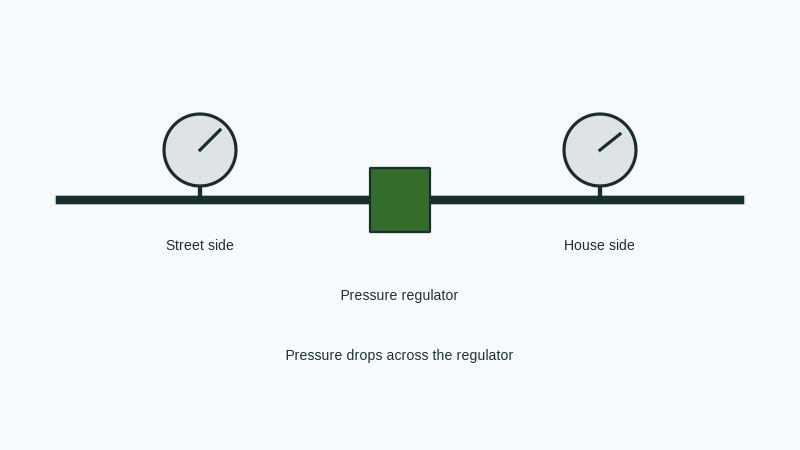
Readings that swing or stay high suggest a failing regulator, or else the supply pressure itself has changed. Water here is bought wholesale from Calleguas Municipal Water District, delivered by Ventura County Waterworks District No. 8 for most of Simi Valley, Golden State Water in the eastern end, and Ventura County Waterworks District No. 1 in Moorpark. If you suspect the supplier's pressure, tell them. For what to compare, see the page on the best home pressure regulator.
Why does the location matter?
You need access to adjust or replace it, and knowing where it is lets you test and diagnose pressure trouble. A regulator buried behind drywall, wedged in a tight crawlspace or under a slab makes replacement harder and pricier.
Every fixture draws its pressure through the regulator, so a failing one appears as high pressure, banging pipes, dripping faucets or weak flow. Testing at a hose bib before and after the valve helps show whether it works. The work itself, and the reason it often needs a contractor, is covered in our page about swapping out a water pressure regulator.
How can you recognize a pressure regulator?
Most are a bell-shaped or domed brass body, around the size of a fist or larger, set into the pipe, topped with a threaded cap or an adjusting screw and locknut. Some are cast iron or have a plastic cap. Arrows on the body mark the flow direction, and a model number is stamped there too.
A dome-shaped fitting in the pipe with a screw on top is almost certainly the regulator. More on its looks is in the page about what a regulator looks like, and the article on a whole-house regulator explains its purpose. Do not casually turn the screw: it sets the pressure for the entire house.
Common questions
How much time does locating and testing a regulator take?
Following the supply pipe to the regulator usually takes ten to thirty minutes, and a gauge test a few minutes more. A plumber's replacement often runs about two hours once the part is on hand. Expect the plumber's own time estimate to come with the written quote.
Which questions should I put to a plumber replacing the regulator?
Confirm whether the quote includes the regulator, fittings, labor, any permit and testing, plus an expansion tank when the plumber recommends one. Request the contractor license number, then check it on the state licensing board website. Ask too which pressure will be set and which warranty backs the work.
Does someone need to be home while the regulator is replaced?
An adult should be there when work begins, to point out the main shutoff and the regulator, and again when it ends, to observe the pressure test and sign off. The supply is shut for a short time, so plan around it. Leave the garage wall or closet clear.
What if I never find a regulator?
Your house may have none, or the supplier's pressure may be modest enough that none was fitted. Measure the pressure at a hose bib. A high or fluctuating reading is a reason to ask a plumber about adding one. If it is fine, nothing more is needed.
Does the regulator come before or after the shutoff valve?
Usually after, so you can close the water prior to working on it. The sequence along the pipe is the meter, then the main shutoff, then the regulator, then the branches into the house. If your layout differs, close the main valve before touching it.