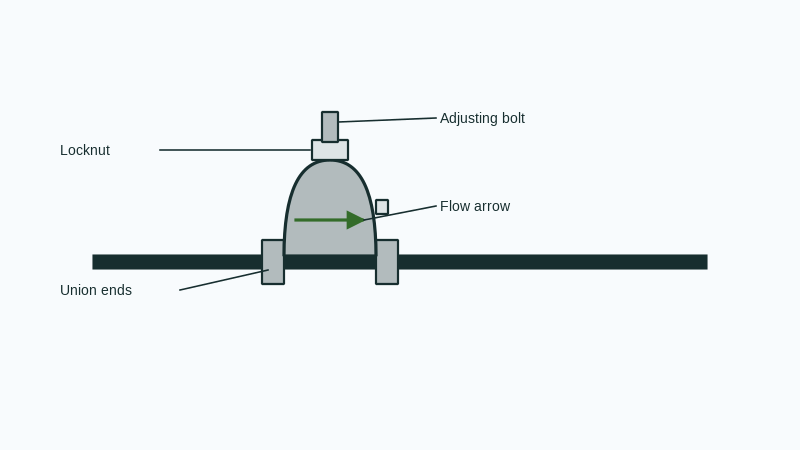
What features identify a water pressure regulator?
Scan the supply line for a brass or bronze body shaped like a bell or squat cone, topped with an adjusting bolt or screw held by a locknut. Most are about as big as a fist or a large coffee mug, with a threaded or soldered union on each side. If a home has one, it sits near where the water enters. That agrees with the guidance on plumbers for low water pressure.
The bell does the work. Inside it, a spring and a diaphragm open and close against the pressure of the incoming water. The bolt on top compresses the spring, which is how the pressure setting goes up or down.
A cast arrow on the body marks the flow direction. If you ever replace one, that arrow has to match the way water flows, so photograph it before disconnecting anything.
Which external parts are visible?
Outwardly you will see the bell-shaped body, the adjusting screw or bolt with its locknut, the flow arrow, threaded or soldered inlet and outlet connections, and often a small plug or port for a pressure gauge. Some models include a union fitting so they can be exchanged without cutting the pipe.
A quick field guide:
- Bell or dome. The rounded housing that holds the spring and diaphragm.
- Adjusting bolt. A hex-head bolt or slotted screw at the very top, with a locknut beneath.
- Flow arrow. Cast into the body, pointing downstream.
- Gauge port. A small threaded plug on some models, used for reading pressure.
- Union ends. Large nuts that allow the regulator to be unscrewed.
Not all regulators have a gauge port. Without one, a screw-on gauge threaded to an outdoor hose spigot supplies the reading.
Where does a regulator normally sit?
Normally it is on the main supply line just past the house shutoff valve, near where the pipe arrives from the street side or the meter. Depending on the house, that could be the garage, an exterior wall, a utility closet or a buried box out front. Not every home has one. See typical regulator locations.
Find the main shutoff first, then trace the pipe a few feet into the house. The regulator typically sits within a few feet, often with the shutoff upstream. Where the pipe passes through a wall or slab, look for an access panel or an outdoor box.
The water meter is a different object, owned by your water supplier and located near the street, so keep the two apart. Water in Simi Valley and Moorpark comes from local retail suppliers, named on your bill, and the meter is theirs to service.
How does a regulator differ from a shutoff valve or relief valve?
A shutoff valve has a handle or lever turned by hand and lacks the spring bell. A regulator has the bell body and the adjusting bolt. A thermal expansion relief valve is a small valve fitted with a lever and discharge pipe, usually on the water heater. A backflow device is a different, larger assembly with test cocks.
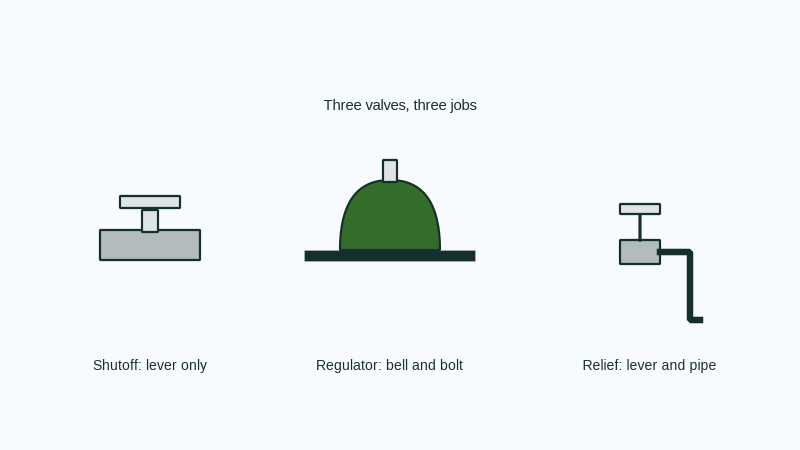
A plain body with a round handle or lever is a shutoff. A bell with a bolt is a regulator. Anything with a discharge pipe near the water heater is its safety relief valve and must never be capped.
Related guides cover variants by size: the 3/4 inch type, the 1 inch type and the half-inch type. A page on the whole-house regulator helps with choosing one.
What are the signs of a failing regulator?
Watch for big pressure swings, pipes that bang or hammer, fixtures that wear out early, weak flow when everything else checks out, or a dripping relief valve at the water heater. A hose-spigot gauge confirms it: pressure that creeps up overnight, or reads far off the setting, points to a failing regulator.
Regulators do not last forever; the diaphragm and seat wear down. If yours is corroded, leaking from the bell or fails to hold pressure, a plumber replaces the unit. The page on regulator replacement explains what is involved.
By EPA figures, leaks cost the typical household more than 9,300 gallons of water per year, and a failing regulator that lets pressure climb can worsen that by stressing fittings and valves. Larger plumbing work brings permits and licensing, and any job that needs a permit must be done by a contractor who holds a California license. No dollar prices are stated here, since none are verified.
When the regulator is nowhere to be found, or you suspect it is failing, ask for a plumber and note where your water line enters the house. We hand your request to a plumbing business close by, and weekday requests are read from 9am to 5pm. The Arroyo Simi Plumbing home page describes the service.
Common questions
Does every house have a water pressure regulator?
No. Many homes have one, especially where supply pressure runs high, but some do not. If none turns up near the main shutoff, a gauge screwed to a hose spigot shows the pressure, and a plumber can advise whether you need one.
What color is a pressure regulator?
Most are brass or bronze, so they look gold or brown, though age can turn them dull or green. A few newer units have a plastic cap or a colored adjuster. The bell shape and the bolt on top are the better clues.
Can I adjust my regulator myself?
The adjusting bolt turns, but plenty of owners hand the job to a plumber, since a wrong setting can overpressure the house and a gauge is needed to set it. If you try anyway, change it in small steps and check the gauge every time.
Is the regulator the same as the pressure tank on a well?
No. A well system uses a pressure tank and switch, which is a different arrangement. Homes on city or district supply, as in most of Simi Valley and Moorpark, use a regulator at the main if they have one. Rural lots may differ.
Where can I learn which regulator size I need?
Match the pipe size at the spot the line enters the house, and check the connection sizes stamped on the old unit if one exists. A plumber can measure for you on a visit. The pages on water main regulators and the best home regulator cover sizing and choice.