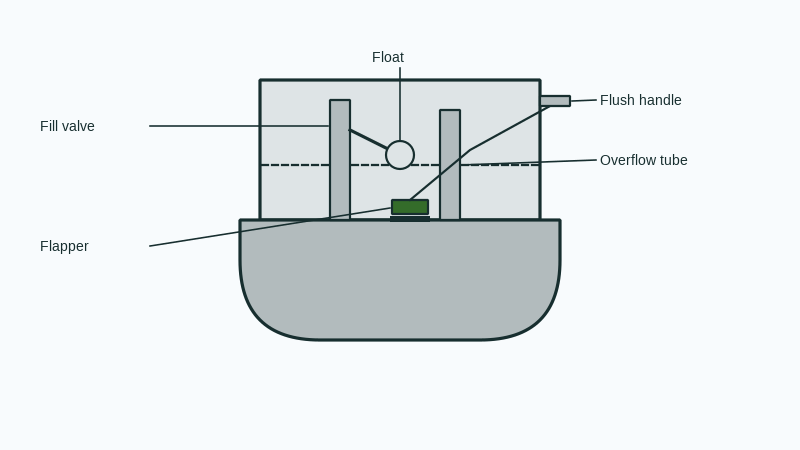
What makes a toilet run all the time?
Either the tank fails to seal, or the fill valve never closes off the supply. Likely causes: a worn flapper letting water seep into the bowl, a chain cut too long or too short, a fill valve jammed open, or a float set high enough that water runs down the overflow tube. For the flapper alone, see toilet flapper repair; the Arroyo Simi Plumbing home page explains how to request toilet repair services.
Lift the tank lid and look inside. If water trickles into the center column, the float or fill valve sits too high. If the level stays below the overflow but you hear a hiss or see ripples in the bowl, the flapper is not sealing. A minute is enough to spot either.
Tract homes in Simi Valley from the 1960s through the 1990s may still have the original fill valve and flapper, and rubber parts harden and warp with age and mineral build-up.
How can I tell if the flapper leaks?
Put several drops of food coloring in the tank, then leave it unflushed for ten minutes. If color shows up in the bowl, the flapper, or the seat beneath it, is leaking. This is a test the EPA recommends, and it lists worn flappers as a frequent cause, advising replacement at least every five years.
Then examine the flapper itself. Press it with a finger: slimy, soft or curled means it is finished. Wipe the seat, the ring it rests on, with a cloth, because scale or grit prevents a seal. A flapper that looks fine but still leaks may sit on a pitted seat, which a plumber can assess.
To replace it, turn off the supply valve at the wall behind the toilet, flush to drain the tank, unhook the worn flapper and chain, and clip on a matching one. Choose the type that suits your flush valve size (2 inch or 3 inch are common), shown on the old part or in the tank manual.
How should the chain and float be set?
Allow the chain slight slack, roughly half an inch, while the flapper is closed. Too tight, and the flapper stays propped open. Too loose, and the chain can wedge beneath the flapper. To adjust the float, lower it until the water sits roughly an inch below the rim of the overflow tube.
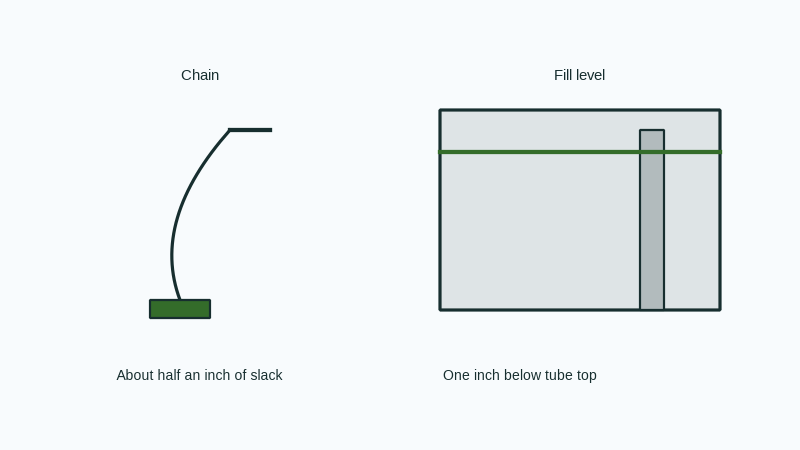
An older ball-float valve responds to a gentle bend of the arm or a turn of the adjustment screw. On a cup-style fill valve, pinch the clip and lower the cup along the shaft, or use the screw at the top. Flush and watch the refill, which should stop cleanly with water roughly an inch beneath the overflow tube.
A valve that hisses even with a full tank is itself worn out. Those parts have their own guides: repairing a fill valve and fixing the overflow tube.
Why is my flush handle not working?
A loose or dead handle usually means a chain that has come off or snapped, a loose handle nut inside the tank, or a worn handle arm. Lift the lid, see how the arm meets the chain, then reattach or tighten. Many toilets use a left-handed thread on that nut, so it loosens the opposite way.
If the chain is attached and the handle moves yet the flapper stays down, adjust the slack. A stiff handle may be catching on mineral build-up at the lever. Swapping a handle is a small job with an inexpensive part. For more flush faults, see toilet flush repair.
A toilet that flushes weakly or only half-flushes is a separate matter, caused by clogged rim jets or a low water level rather than the handle.
Does a running toilet push up my water bill?
It does. The flow is so quiet that water seeping into the bowl or running nonstop can waste a lot before anyone notices. The EPA estimates that a typical home loses over 9,300 gallons a year to leaks, with toilets among the most common sources.
Check your meter. Switch off every appliance that uses water, record the reading, and leave everything unused for a couple of hours before looking again. If the figure has moved, a leak exists, and the toilet is the first suspect. Guides to a high bill without a visible leak and why a water bill is high cover other causes.
If the toilet runs on after a fresh flapper and a fill valve adjustment, a plumber can inspect the seat, valve and tank.
Stuck with a toilet that will not behave? Ask for a toilet plumber, describing what you see and hear. A nearby plumbing business gets your request from us, and requests are read between 9am and 5pm, Monday through Friday. If the shut-off valve at the wall will not close, start with shut-off valve repair.
Common questions
Does a running toilet count as an emergency?
Rarely, though it merits a quick fix because it wastes water and money. If the bowl overflows or water hits the floor, turn the toilet's stop valve to closed. A slow trickle can wait a day or two until you pick up a part.
Is a running toilet a do-it-yourself repair?
Mostly, yes. A new flapper, chain or fill valve takes no special tools, and the water supply can be stopped right at the toilet. Hire a plumber if the shut-off valve leaks or the tank has cracked.
What does a running toilet repair cost?
No local figure has been verified, so none appears here. Parts are usually inexpensive, which keeps a do-it-yourself fix cheap. A plumber's price depends on the parts, the time and the visit. Obtain a written quote before any toilet repair begins.
Why does my toilet run every few minutes?
Most likely a phantom flush: a slow flapper leak lowers the water in the tank until the fill valve tops it up, and that repeating cycle is the sound you hear every few minutes. Try the dye test described above. If color reaches the bowl, replace the flapper and inspect the seat.
Does a leaking toilet affect my sewer or water bill?
The water bill, yes, because the water was metered as it came in. Whether a sewer charge climbs too depends on how your supplier or city bills for it, which we cannot say for your address. Look at the bill itself or ask your water supplier directly.
At what point is a whole new toilet needed?
Replace the whole toilet if a crack runs through the bowl or tank, the base leaks, or one repair after another keeps failing. A cheap running problem deserves a fix first, since new parts often revive an older toilet that is otherwise sound. For help deciding, read about toilet replacement cost and toilet leaks.