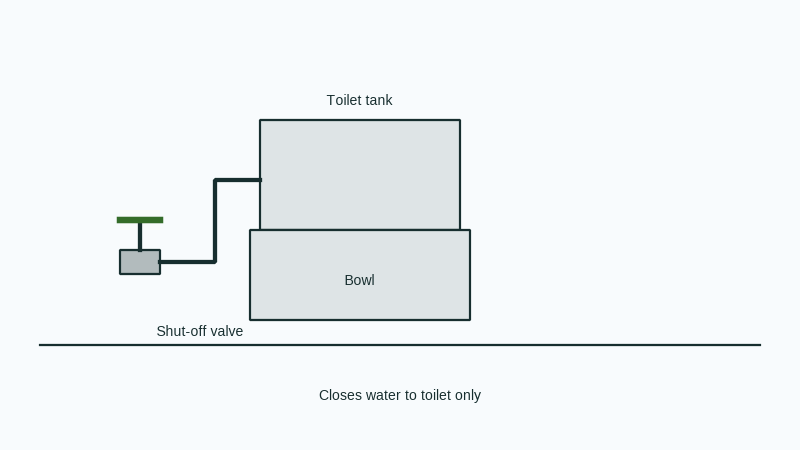
Most people only touch the shut-off valve after something has gone wrong, which is when a stuck or dripping valve does the most harm. A failing valve can also turn a ten-minute toilet repair into a job that needs the whole-house main. The sections explain what the valve is, how to recognize one that is going bad, how to fix it, and when a plumber should take over. Browse the jobs local plumbing businesses take through us across Simi Valley and Moorpark on the home page.
What does the toilet shut-off valve do, and where is it?
An angle stop, the usual name for the toilet shut-off valve, sits behind the bowl, mounted on the wall or rising from the floor. Closing it cuts water to that toilet alone, while other fixtures keep working. Turn the oval handle clockwise to close. Test it before starting any other toilet repair, from a new fill valve to a full replacement.
A braided or plastic supply tube joins the top of the valve to the underside of the tank. Together they are the toilet's only link to the water supply. The valve may be a multi-turn type with a round or oval handle, or a quarter-turn type with a lever. Both do the same job, and the quarter-turn type is less likely to seize.
No valve behind the toilet at all is a hidden danger, since the house main is then the sole way to halt the flow. Fitting one is a minor task for a plumber and worth doing ahead of the next repair.
When should a plumber handle the toilet stop valve?
Hire a plumber if the valve cannot be closed, leaks at the wall, sits on corroded wall pipe or a soldered stop, or if there is no way to shut off water to the house. Wall pipe work is where a small fix grows, and a plumber can also replace the supply line and check the rest.
A leak at the wall can soak the drywall and the floor behind the toilet, so act quickly. If water is already spreading, close the house main and dry the area, then arrange a repair. A wall pipe repair may need a permit; ask the Building and Safety office of the city.
In the quote form, describe the toilet, the valve type if you can tell, and the symptom. We send your request to a local plumbing business, and businesses that accept requests pay us a fee. Before any work begins you get a written quote. Requests are read on weekdays between 9am and 5pm, and nothing is promised about how fast a reply comes. If the leak is at the base of the toilet rather than the valve, see toilet leak help.
How do I know the shut-off valve is failing?
A valve needs repair when it drips at the stem or the supply connection, when the handle will not turn, when it turns but water still reaches the tank, or when green or white crust covers it. Any one of those is a reason to act before the next toilet job, because a valve you cannot trust can make a small repair end in a flood.
Find slow drips by wrapping a dry tissue about every joint, then checking it for dampness an hour later. A drip at the stem means the packing is worn. A drip at the supply nut means a loose or tired washer. A drip at the point the valve joins the wall indicates the wall connection and is more serious.
Work the valve once a year: close it, flush the toilet, and watch whether the tank refills. If it does, the valve is not sealing. Then reopen it and confirm it opens fully. A valve that opens only partway restricts flow into the tank, causing slow refills and weak flushes. According to the EPA, household leaks can waste up to 180 gallons a week, and toilets are often the cause, so even a small drip deserves a fix.
Why do old toilet stop valves seize up?
Old valves often seize because minerals and corrosion lock the stem and the washer inside hardens. Simi Valley houses built in the 1960s through the 1990s may still have their original stops. Never force a stuck handle: a snapped stem can mean the house main is the only way left to halt the water.
The stem packing dries out, the seat scales over, and the valve is rarely used, so it sits for decades. Turning each valve in the house a few times a year keeps the parts moving. If the valve is stiff when you test it, plan to replace it at the next toilet job instead of waiting for it to fail.
When the whole toilet is being replaced, swap the valve and the supply tube too. They cost little compared with the visit, and the toilet is already out of the way. Toilet replacement pricing lists what quotes should include, and the guide to a running toilet helps if the valve is not the only problem.
Is a dripping stop valve repairable, or does it need replacing?
A stem drip can often be stopped by nudging the packing nut, but a worn, stiff or corroded valve is better replaced. Steady the valve body with one wrench and turn the packing nut a quarter of a turn with a second. If it still weeps or the handle spins loose, replace it.
For a drip at the supply tube, close the valve, drain the tank, and inspect the washer or cone inside the nut. A cracked or flattened washer is a cheap fix, and a new braided supply tube is inexpensive. Avoid overtightening; the usual rule is hand-snug plus one more quarter turn, because excess force may crack the fitting or damage the valve.
Never force a handle that refuses to budge. Spray penetrating lubricant on the stem, wait, then try gently. If it stays stuck, replacement is the safer route. Pliers on a corroded stem can snap it.
Repair visits of this kind often include the valve, the supply tube and a short inspection of the flapper and fill valve, since these parts wear on the same schedule. The pages on inlet valve repair and fill valve repair cover the parts inside the tank.
How is a toilet shut-off valve replaced?
Replacing the valve starts with turning off the water for the whole house, because the valve itself is what failed. Drain the line, detach the supply tube, remove the old valve and fit a new one that suits the pipe type. How it attaches depends on the wall pipe: compression and push-fit fittings suit many owners, while soldering takes practice.
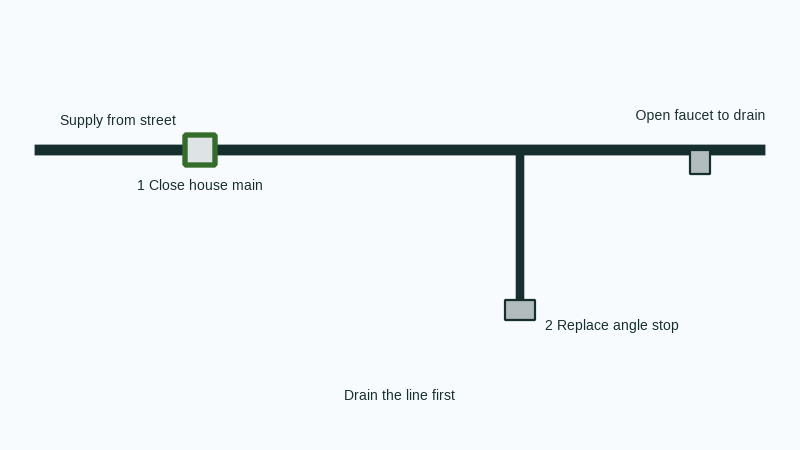
Begin by closing the house main, then drain the lines by opening the faucet at the lowest point of the house. Shut the old valve, flush, and sponge the leftover water from the tank. Unscrew the supply tube from the valve, then loosen the compression nut that holds the valve to the pipe. Slide the valve and its brass ring off. If the ring is stuck, a ring puller is safer than prying.
Put a fresh compression ring and nut on the new valve, tighten by hand, then add a snug quarter to half turn with a wrench. Reconnect the supply tube and open the main slowly, checking every joint for drips. Open the valve fully, flush several times, and look again an hour later by running a dry paper towel past each joint.
Which valve you buy depends on the wall pipe: copper, a stub-out of plastic, or older galvanized steel. Galvanized pipe corrodes inside, and a valve threaded onto it can fail when the old pipe breaks. If the pipe looks rusted or crumbles, stop and see galvanized pipe replacement.
Common questions
How long does a plumber take to replace the valve?
When the right valve is on hand it is typically a short job, and longer if corrosion has reached the wall pipe or no shut-off exists upstream. Expect the toilet to be out of use for a while. The plumber gives a time guide on the day. The form carries no promise of a response time.
What should I ask the plumber before a valve replacement?
Find out whether the quote includes the valve, a new supply tube and a leak test, whether the job needs a permit, and what the plan is if the wall pipe proves damaged. Get the price in writing, and check the contractor's license number through the website of the California Contractors State License Board.
Is a stiff stop valve normal?
It is common on older valves, though it is a warning sign. A valve that is stiff may seize completely, and forcing it can snap the stem. Replace it before it fails, ideally when the water is already off for another repair, and do not use it as the only protection in an emergency.
Which way do you turn a toilet shut-off valve?
Clockwise closes a multi-turn valve, so turn the handle to the right until it stops, without forcing it. On a quarter-turn valve, a lever crosswise to the pipe means closed, and in line with the pipe means open. If you are unsure, flush after closing it and see whether the tank refills.