Preventing scale starts with a number. Hardness is measured, not guessed, and the figure tells you whether a few cheap habits will do or a whole-house softener is worth pricing. This page covers the scales used to report hardness, the damage scale does to a water heater and pipes, and how to head it off. Other jobs we arrange in Simi Valley and Moorpark are on the home page. For the installation side, see how a water softener is installed.
How should I read hardness in ppm and gpg?
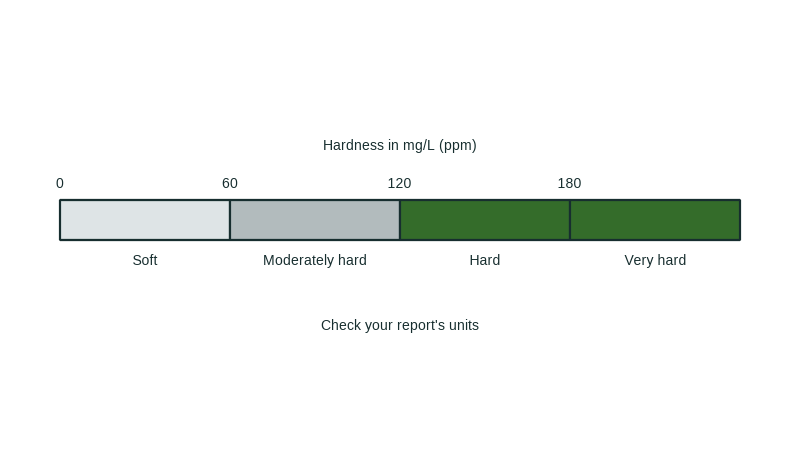
Hardness is reported in one of two units: milligrams per liter (effectively the same as parts per million, ppm) or grains per gallon (gpg). The US Geological Survey calls water soft up to 60 mg/L, moderately hard from 61 to 120, hard from 121 to 180 and very hard above 180. One grain per gallon is about 17.1 mg/L.
| USGS class | Hardness in mg/L (ppm) | About, in grains per gallon |
|---|---|---|
| Soft | 0 to 60 | up to 3.5 |
| Moderately hard | 61 to 120 | 3.5 to 7 |
| Hard | 121 to 180 | 7 to 10.5 |
| Very hard | over 180 | over 10.5 |
The grain figures are our own conversion from the USGS bands. Water suppliers' reports may use either unit, so check which yours uses before comparing it with a softener's rating.
What produces scale in the first place?
Dissolved calcium and magnesium are the usual cause. The USGS says that when hard water is heated, as in a home water heater, solid calcium carbonate deposits can form. Over time those deposits narrow pipes, cut flow and pressure, and can shorten equipment life.
The minerals come from the ground. Water picks up small amounts of calcium and magnesium as it travels through soil and rock, and carries them along. Heat turns the dissolved minerals into a solid, which is why a water heater, a kettle and a showerhead collect scale first.
The USGS adds that scale can raise heating costs and reduce how efficiently electric water heaters run. In daily life you notice crusty faucet aerators, a showerhead that sprays sideways, cloudy glassware, and a water heater that rumbles. Cleaning what has already formed is covered in our guide to removing hard water scale.
How do I find my own water hardness?
Read your water supplier's yearly water quality report, or test a sample yourself. Ventura County Waterworks District No. 8 serves most of Simi Valley and Golden State Water Company the eastern end; Moorpark is served by Ventura County Waterworks District No. 1. Your bill shows which you have, and each publishes a report.
We could not find a hardness figure for these supplies in a source we can stand behind, so none is printed here. Open your supplier's latest report, look for hardness or total hardness, and note the unit. Home test strips cost little and give a rough class; a lab test is more precise.
Some of the water from all three suppliers is bought from Calleguas Municipal Water District, but the mix and the hardness can differ between suppliers and from year to year. That is one more reason to rely on the report for your own address rather than a general figure for the area.
How do I stop scale building up at fixtures and the water heater?
You either take out the minerals before they heat or manage the spots where scale forms. A softener strips calcium and magnesium for the whole house, which treats the cause. Cheaper steps are descaling showerheads and aerators regularly, flushing the water heater tank, and avoiding a hotter setting than you need.
For showerheads and aerators, a soak in white vinegar and a gentle brush usually frees the holes. Repeat every few months where water is hard. Scale-removal products sold for kettles and fixtures work the same way, and their labels should be followed, especially on brass or coated finishes.
Flushing a tank water heater drains sediment from the bottom, and it needs care, because the water is hot and a stuck drain valve can be awkward. Many people leave it to a plumber. Check the heater's manual, and read our water heater page for when a visit makes sense. Since scale forms as water is heated, a lower temperature setting can slow it, within the limits your household needs for safe, comfortable hot water.
Scale that has already narrowed your pipes will not be reversed by a softener. A plumber can assess whether sections need replacing, and for older steel lines see galvanized pipe replacement.
Do anti-scale conditioners and softeners work?
Anti-scale conditioners claim to change how scale forms instead of removing the minerals, and the evidence differs by device. A salt-based softener is the established way to cut hardness, but it needs salt, a drain connection and sometimes a permit. Ask any seller for independent test data on your own water before buying.
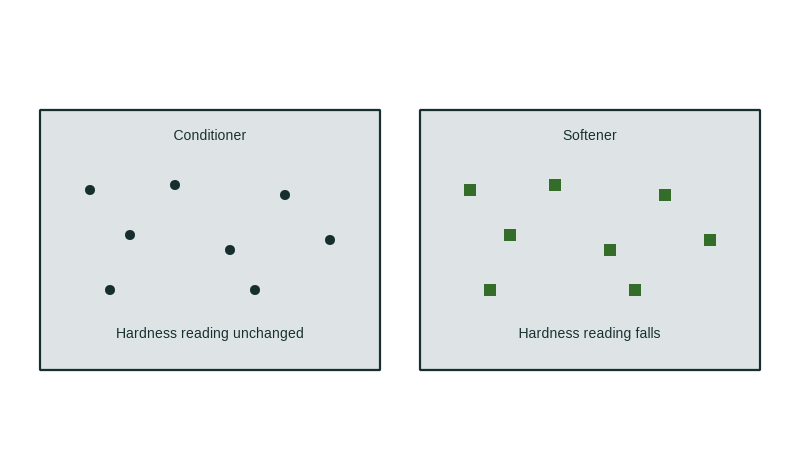
A conditioner leaves hardness in the water, so a hardness test afterward still shows the same number. A softener trades sodium or potassium for the calcium and magnesium in the water, so the hardness reading drops. Think about what you want: protecting a water heater, easier cleaning, or both.
Pricing and sizing depend on your hardness number and how much water the household uses. Read softener installation cost and whole-house softener cost for the factors, and what a softener does to your water bill if running costs worry you. For booking, see water softener installation service.
Does pH measure the same thing as hardness?
They are different measures. pH shows how acidic or basic water is on a scale of 0 to 14, while hardness shows how much calcium and magnesium it carries. Water can be hard and near neutral at once, so a pH reading cannot tell you how hard it is.
If a test kit gives both numbers, read them separately. A softener targets hardness and does not adjust pH. Blue-green staining or pinhole leaks in copper are a different issue from scale, and a plumber should examine the pipe and the water chemistry rather than guess.
When is it time to involve a plumber over scale?
Bring in a local plumber if scale has cut flow at several fixtures, if the water heater is noisy or slow to heat, or if you are weighing a softener. Plumbers can test hardness, check for scale in the heater and supply lines, and explain where a softener would go and what it needs. Ask for the quote in writing.
Note what you have already tried, your hardness reading and how old the water heater is. Send the quote form, and a local plumber will be lined up to visit you. Requests are read on weekdays between 9am and 5pm.
Common questions
How long does it take to tackle hard water scale?
Descaling a showerhead needs roughly an hour, soaking time included. For a plumber, flushing a water heater is a brief visit. A whole-house softener is a larger job, and the plumber sets the schedule after seeing where it would go. No response times are promised through our form.
What should I ask someone about hard water treatment?
Ask for your hardness to be measured, not assumed, and ask what type of treatment they propose and why. Ask what it needs in salt, drain connection and servicing, and if a permit is needed. Have the scope and price put in writing, and verify the contractor's license through the website of the California Contractors State License Board.
Is hard water bad for a water heater?
Yes. The USGS says scale from heated hard water can cut equipment life short, push up heating costs and reduce the efficiency of electric water heaters. Regular flushing and sensible temperature settings help. If your water heater is noisy or slow, ask a plumber to check for sediment and scale.
Can I drink hard water without concern?
The USGS page we used covers scale and equipment rather than health, so we make no health claim here. For questions about what is in your tap water, read your supplier's yearly water quality report or contact the supplier directly.