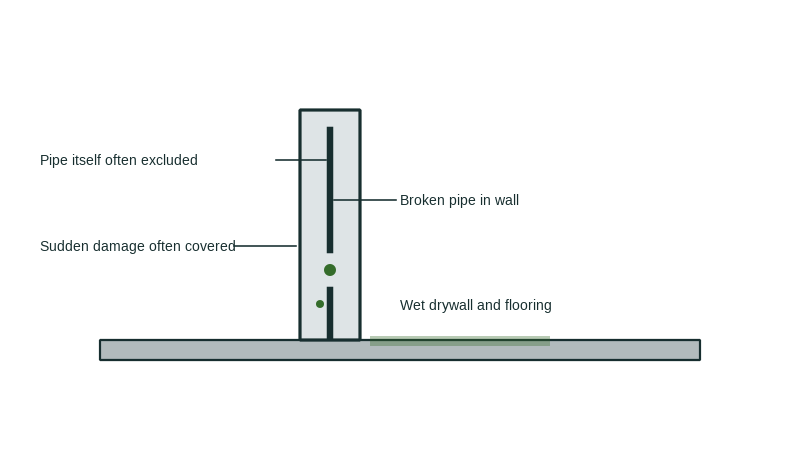
Arroyo Simi Plumbing is a plumbing referral service, not an insurer, so what your policy covers is outside our knowledge. What we can describe is how such claims tend to go: a standard homeowners policy commonly responds to sudden and accidental water damage, and commonly does not pay to replace a pipe that failed from age, corrosion or neglect. Your policy's wording decides. The page on leaking pipe repair covers the plumbing side. Next come the steps that protect a claim, the questions to put to your insurer, and where a plumber's written report helps.
Does a homeowners policy pay out for a burst pipe?
Usually the sudden damage is covered, and the pipe itself may not be. Many policies pay to dry out and repair walls, floors and belongings after an abrupt burst, and may exclude the cost of fixing the broken pipe. Slow leaks, wear and tear and neglect tend to be excluded. Go through your policy or ask the insurer directly.
An insurer typically calls a loss "sudden" when it happened abruptly and was not expected. A joint that lets go overnight fits. A pinhole that has dripped behind a wall for months usually does not, because the policy may treat that as maintenance or gradual damage. Details vary by company and by policy, and we have not verified wording from any insurer, so the points below are what to ask rather than what you will be told.
Ask these questions, in writing where you can:
- Does my policy cover water damage from a sudden pipe burst, and what deductible applies?
- Are the costs of finding the leak, including opening a wall, covered?
- Is the broken pipe itself covered, or only the damage that followed?
- Does the policy exclude gradual leaks, and how does it define "gradual"?
- Is a slab leak handled differently, given the pipe sits beneath the house?
What should I do right after a pipe bursts?
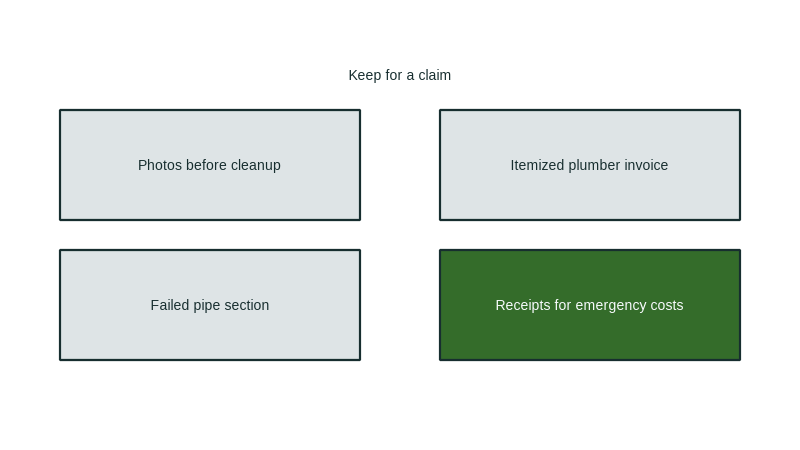
Stop the water, protect the house and document everything. Close the main shutoff, switch the water heater off, and stay away from any area where water meets electricity. Carry belongings out of the soaked area, then take photos and video of the damage before cleanup. Contact your insurer promptly.
Most policies require you to take sensible steps to limit further damage, such as closing the water, and may refuse to pay for damage that grew because you did not. Keep receipts for emergency costs such as fans, a dehumidifier or a temporary repair. Hold on to the failed pipe section if the plumber removes it, as the insurer may want to see it.
The page on burst water pipes walks through the shutoff in detail, and the emergency burst pipe page describes how a visit runs.
When should a plumber come into the picture?
Right after the water is stopped, since the plumber can find the cause, repair the failure and give you a written report for the claim. For a hidden or slow leak, have detection done before any wall is opened, so the cause is documented.
What does an insurer expect from the plumber?
A plain written account: what failed, where, the apparent cause, and what was done. A plumber can write down what they saw and fix the break. Whether it is covered is the insurer's decision. Ask for an itemized invoice, with labor and parts separated, and photos from the visit.
Ask the plumber whether the cause looks sudden or gradual, and to write only what they can observe. Do not pressure anyone to describe a failure in a way that suits a claim. An honest report protects you; a misleading one can sink the claim and cause trouble beyond it.
If the leak was hard to find, a leak detection report matters. The guide to leak detection cost explains the methods, and the page on why pipes burst lists common causes a plumber might name.
Is a slab leak treated differently from an ordinary burst?
It can be. A slab leak sits in a pipe beneath the concrete floor, and locating and reaching it is costly. Some policies pay for access and repair of the damage but not the pipe, or set separate limits or exclusions. Ask your insurer directly whether slab leaks are covered and how.
The EPA estimates the average home loses upwards of 9,300 gallons of water a year to leaks, so a slow leak caught early beats one discovered through a flood. A meter test with every fixture off, described in the guide to a big bill with no visible leak, shows whether water is escaping.
Who should do the repair, and are permits needed?
Hire a contractor whose license you have checked. Under California rules a contractor license is generally needed once a job's labor and materials add up to $1,000 or more, and also for any work that needs a permit, such as re-piping or a water heater swap. The state board's website, cslb.ca.gov, lets you look up a license number.
An unlicensed repair can complicate a claim and the later sale of the house. Get a written quote before work, and know that California caps deposits at $1,000 or 10 percent of the contract price, whichever is less. Permits in Simi Valley are issued by the Building and Safety counter on Tapo Canyon Road, and in Moorpark by the department located in City Hall; confirm hours before visiting.
If you want a visit arranged while the insurer works through the claim, we send your request to local plumbing businesses across Simi Valley and Moorpark. The plumbing businesses that accept these requests pay us a fee. You decide on a written quote.
Common questions
What is the usual time for fixing a burst pipe?
With access, the break itself is often fixed in a few hours. Drying out, replacing drywall and flooring takes longer and is usually separate work. The written quote will include a time estimate, and it should keep the pipe repair apart from any drying or rebuilding.
Which questions belong in my conversation with a burst pipe plumber?
Request the contractor's license number and check it against the state board's records, plus a written quote itemizing labor and parts, photos of the failed pipe, the warranty in writing, and an answer on whether the job needs a permit. Keep every receipt for your insurer.
Must someone be at home during the work?
Yes, an adult ought to be present to let the plumber in, point out the shutoff, approve the work and watch the repair being tested. If nobody can be, tell the plumber when you make contact and arrange another way. Clear a path to the shutoff and the damaged area first so work can start without delay.
Could a claim push my premium up?
We cannot say. It depends on the insurer and your history, and we have not verified how any company rates claims. Ask your insurer or agent before filing, and whether a small claim is worth the effect on renewal. Written answers from the insurer are more useful than a spoken conversation.
Is it okay to repair the pipe before the adjuster comes?
Stop the damage first, but photograph everything and keep the failed pipe if you can. Tell the insurer before making permanent repairs, and ask what they require. Find out whether the adjuster wants to see the damage before drying starts, and keep wet materials until they say otherwise. Other guides cover more on leaks.