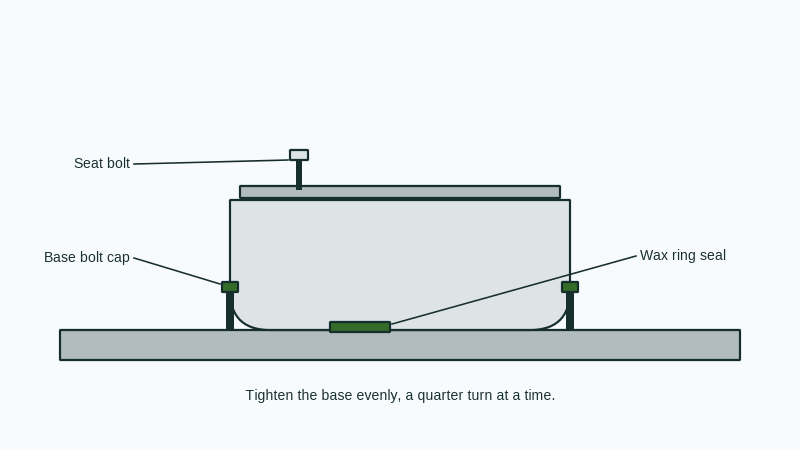
A toilet seat is held down by two bolts near the back of the bowl, and snugging them up normally ends the wobble. If the seat still slides, the bolts or plastic nuts are worn, and a new set costs little. A bowl that rocks against the floor is a different job, and a more important one. If you want a local plumbing business to handle it, start at Arroyo Simi Plumbing, where we forward requests, and the businesses that accept them pay us a fee.
What is the way to snug up a loose seat?
Lift the small plastic caps at the back of the seat, steady the nut underneath with one hand and turn the bolt with a screwdriver until the seat stops moving. Avoid overtightening, since plastic cracks. If the bolts spin freely, grip the nut with pliers or swap in a new seat bolt kit.
Steps in order:
- Flip up the covers on the hinge to expose the bolt heads.
- Look under the rim at the back: the nuts are there, and some are wing nuts turned by hand.
- Turn the bolt clockwise while keeping the nut still.
- Center the seat on the bowl before the final tightening.
- Test the seat. It should not slide when you push on one side.
A bolt rusted solid needs penetrating oil and some waiting. As a last resort a hacksaw blade can cut the bolt below the nut, and the replacement kit fits the same holes. Some seats now clip off for cleaning and use a cam-type fitting, which calls for the manual.
A stripped hole in the bowl is rare. If the seat bolt holes crack, the bowl itself is damaged, and you should replace the toilet rather than patch it.
What do I do if the toilet base rocks on the floor?
A rocking base means the toilet is not firmly anchored to the floor flange. Snug the nuts on the closet bolts at the base in small steps, alternating sides, and shim any gap. If it keeps rocking or water shows at the base, the wax ring has failed and the toilet has to be raised and reseated.
Why this matters: a loose toilet breaks the seal at the flange, which can leak sewer gas or water under the floor. In any older home, a slow leak can rot the subfloor before anyone sees it.
How to tighten:
- Pop off the caps over the bolts at the base.
- Turn each nut a quarter turn per pass. Too much force cracks the porcelain.
- If the toilet still rocks because the floor is uneven, use plastic toilet shims and trim them flush, then caulk around the base.
If you see staining or feel a soft floor, stop and read toilet leaks. Most owners can reseat a toilet using a fresh wax ring, but it is heavy, so get help lifting it.
How can I repair a stiff or slack flush button or handle?
Remove the tank lid and inspect the linkage. A loose handle needs its nut tightened from inside the tank, and a button usually works a rod or cable that has slipped off its clip. Reattach the part, check the movement, and replace the whole mechanism if the plastic is cracked.
For a lever handle:
- The nut sits inside the tank on a reverse thread, so clockwise loosens it and counterclockwise tightens it.
- Make sure the lever arm is straight, and that the chain or link joins the flapper with roughly half an inch of play.
For a button or dual flush:
- Lift the button cap or the cover plate, as the manual shows.
- Check the plastic rods or cable between the button and the flush valve.
- Adjust the length so the flapper lifts fully but still seals when released.
Which steps replace a toilet handle that uses no chain?
Some tank levers rely on a rod or a clip rather than a chain, while others use a chain. To change one, close the water, undo the old handle nut inside the tank, slide the handle out, fit the new one with its nut and connect the new link to the flapper as the instructions show. Pick a handle for the side your tank needs.
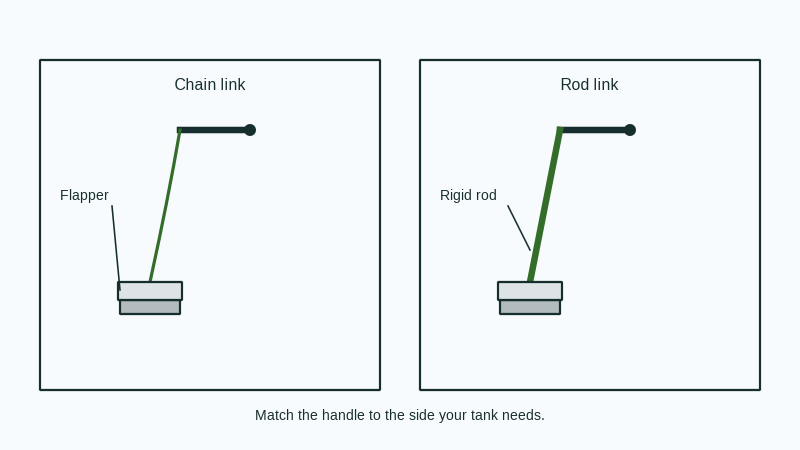
Buy by tank type, since handles come for front, side and angle mounts. A replacement with a chain needs the chain length adjusted to leave slack. A chain-free design uses a rigid rod, which has less to snag. Turn off the supply, flush, and have a towel handy.
With the new handle attached, flush several times and confirm that the flapper rises and drops cleanly.
Why does my toilet flush sluggishly, and what cures it?
Weak flushing stems from clogged rim holes, a low tank water level, a flapper that closes early, or a partial blockage further down. Inspect the tank level and chain first, then clean the rim holes beneath the bowl's rim. If the bowl keeps draining slowly, a drain blockage is more likely.
Quick fixes:
- Tank level. It should reach the line marked in the tank. Adjust the float.
- Rim holes. Mineral deposits block them. Scrape them with a bent wire or a small tool.
- Flapper. If it falls too soon, shorten the chain slack a little, or fit a new flapper.
- Blockage. If the water rises in the bowl or gurgles, see how to clear a blocked toilet.
For more on flush faults, see the toilet flush repair page and the flapper repair page. If the flush valve itself is worn, the repair is a full replacement of that mechanism, which is covered on those pages.
How do I deal with a leaking toilet tank?
Tank leaks originate at the tank-to-bowl bolts and washers, the fill valve connection, the supply line or a crack. Dry the tank and its exterior, then watch where water appears. New bolt washers and a new tank gasket cure most leaks between tank and bowl. A cracked tank must be replaced.
To locate the source:
- Dry everything, tuck paper towel under the joints and wait.
- Dye test: EPA describes adding a small amount of food coloring to the tank. Should color reach the bowl within about ten minutes without a flush, water is leaking past the flapper.
- Check the supply connection under the tank and the shut-off valve.
Small leaks accumulate. EPA notes that leaks in a household can waste large amounts of water over a year, so never ignore a drip. Read your water meter after two hours of no use: if it moves, a leak exists somewhere.
When should I hire a plumber for a toilet problem?
Hire one if a toilet rocks and leaks at the base, the porcelain is cracked, bolts are seized, the shut-off valve refuses to turn, or you have repaired the visible parts and it still misbehaves. A plumber can set the toilet back down with a new wax ring and inspect the flange and floor.
When you send a quote request, name the fault you see and the toilet's age. Paid plumbing work in California above a small threshold calls for a contractor license, so verify the license on the CSLB website before agreeing. For the shut-off valve, see toilet shut-off valve repair.
Common questions
How long does it take to tighten a seat?
A few minutes to tighten a seat, and about fifteen to fit a new one. Reseating a rocking toilet with a new wax ring takes around an hour. A plumber may need longer if the flange or subfloor is damaged, because that must be repaired before the toilet can be set firmly back down.
What should I ask a plumber regarding toilet repairs?
Find out whether parts such as wax rings, bolts and gaskets are included, what the minimum charge is, and whether they inspect the floor for damage. Get a written quote. Verify the contractor license number at the CSLB website. Also ask who removes the old toilet if a replacement proves necessary.
What makes a toilet seat keep working loose?
Worn nuts, stripped bolts or a plastic fitting that cracks with use could be the reason. Fit a new bolt kit, and use the correct size. A slight lean in how people sit can loosen hardware over time, so check it again in a week.
Does a rocking toilet pose a danger?
Not by itself, but it can break the wax seal and leak. Water under the floor causes damage that shows up late. Fix a rocking toilet soon, and stop using it if water appears at the base. Check the floor around it for soft spots or staining, since those show the seal has already been leaking.