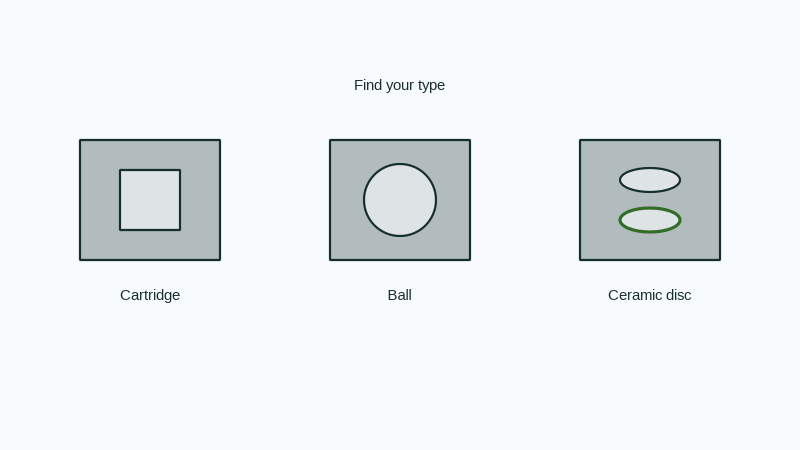
Why does a one-lever faucet start to leak?
When the spout drips, the usual culprit is a worn ceramic disc, cartridge or ball assembly, whereas tired O-rings account for leaks around the base or beneath the handle. One lever works by sliding a single internal part against rubber or ceramic seals, which wear down with use and mineral scale. For sink plumbing in general, see the kitchen fixtures and disposal page.
Pair the leak with the part. A spout that keeps dripping once shut off points to the cartridge or its seats. Water pooling around the foot of the faucet, or running down the body, points to O-rings. A handle that wobbles often has a loose retaining nut or set screw rather than a leak, though you should check under the sink for moisture as well.
Hard water speeds up the wear. Calleguas supplies Simi Valley and Moorpark through local suppliers, and the yearly water quality report from each supplier lists hardness. Grit and scale scour the seals, so a cartridge in a hard-water home may fail sooner.
Which design of one-lever faucet is in my kitchen or bath?
Examine the handle and the base. A cartridge faucet has a stem that lifts and swivels, with a retaining clip or nut under the handle. Delta kitchen models are often the ball type, which shows a rounded cap with an adjustable ring under the handle. A ceramic disc faucet, often with a wide cylinder body, holds discs inside the cylinder.
If you cannot tell, pull the handle off and peer inside. What sits underneath settles the question. Photograph it, and bring the part you removed to a hardware store, because cartridges and kits are specific to brand and model. The maker's name stamped on the faucet, often on the base or underside, prevents buying the wrong one.
Never buy a generic cartridge without checking its dimensions. Two cartridges that look the same can differ by a few millimeters and leak just as badly.
How do I swap the cartridge?
Close the supply and plug the drain. Then remove the handle, release the retaining nut or clip, draw out the old cartridge and seat its replacement pointing the same direction. Fit fresh O-rings, smear on plumber's grease, put the faucet together and test. Open the tap before restoring the water so air can escape.
The steps in detail:
- Shut off the water. Turn both stop valves beneath the sink to closed, then open the faucet to drain the line.
- Plug the drain so tiny screws cannot disappear.
- Remove the handle. Pry off the cap, loosen the set screw with a hex key or screwdriver and lift off the lever.
- Take out the retaining nut or clip along with any decorative collar.
- Pull the cartridge straight up. Note which way the hot and cold marks face.
- Install the new cartridge facing the same way, after rubbing a thin film of grease onto the O-rings.
- Put it back together, open the tap, let the water return slowly and watch for drips.
Ball faucets call for a repair kit with springs and seats. Replace every piece, not only the ball.
What stops a leak around the foot of the faucet?
Remove the handle and collar, then the spout, which often lifts or twists off once a set screw is released, and replace the O-rings on the body. Coat the new rings in plumber's grease, push the spout back on and tighten the cap. Base leaks usually come from spout O-rings that have dried and cracked.
If water still escapes, inspect the faucet body for cracks and the supply hoses beneath the sink. A leaking hose can pass for a faucet leak. Dry everything with a paper towel and see which part gets wet first. Should the water come from the pipes, see the guide to leaks under a sink.
When the faucet is aged, pitted or losing its finish, replacing it is often smarter than rebuilding. Budgeting for that is covered under faucet replacement cost.
When do I need a new faucet or a plumber?
Hire a plumber when the shut-off valves will not close, parts refuse to come loose, the faucet body is cracked or corroded, or repairs have not stopped the leak. One visit lets the plumber replace both the valves and the faucet. If a fresh cartridge fails to cure it, the seats within the body may be worn.
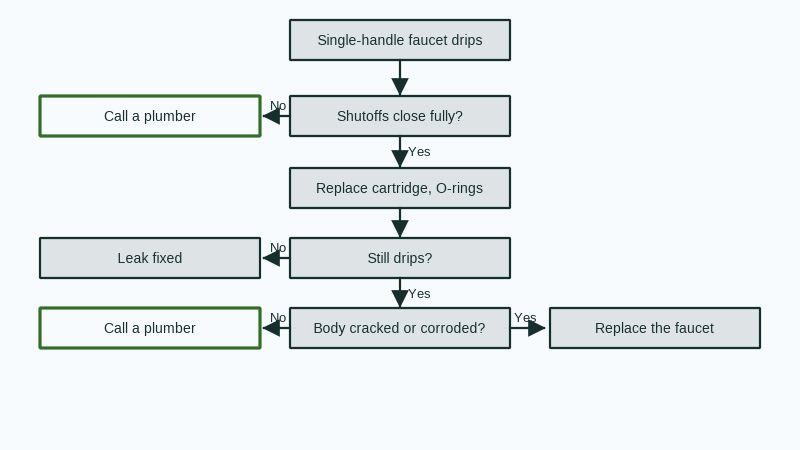
A decades-old faucet with hard-to-find parts is another good reason to replace it. For costs in a wider view see installing a faucet, and for the other style see a leaky two-handle faucet. A faucet swap seldom needs a permit or reaches $1,000, which is where California's contractor license rules start, but check the license of anyone you hire. We state no dollar prices here, since none are verified.
If the faucet keeps dripping, ask for a plumber and name the faucet brand and where it leaks. We hand your request on to a local plumbing business, and the businesses accepting it pay us a fee. Requests are read Monday to Friday, 9am to 5pm. The Arroyo Simi Plumbing home page explains how the service works, from faucets to the shower.
Common questions
Why is my one-lever faucet still dripping when closed?
The seals on the cartridge, ball or disc have worn, or scale prevents them closing. Fit a new cartridge or repair kit and the drip normally ends. The EPA notes that worn washers and gaskets often cause drips, and advises shutting off the water before repairing.
Do I need special tools to change a cartridge?
Normally a hex key, a screwdriver, pliers or an adjustable wrench will do, plus a cartridge puller for stuck parts at times. Plumber's grease lets the new seals slide in and last longer. Most jobs need nothing extra, and a puller is an inexpensive add-on when a cartridge has seized.
How much does a faucet repair cost?
We have confirmed no local figure, so none is printed here. A cartridge or repair kit is a modest part, whereas a plumber's price depends on time spent and parts used. Before agreeing, request a written quote that splits labor from parts.
Why is my faucet handle loose?
Usually a set screw or retaining nut has worked itself free. Tighten it with a hex key or wrench, and replace the screw if it just spins. When the handle still moves after that, the cartridge underneath may be worn and need replacing, which is a short job with the right part.
How long does a faucet cartridge last?
No fixed lifespan can be verified. It depends on how often the faucet is used, how hard the water runs and how good the cartridge is. A faucet that starts to drip or feel stiff after years of use is signaling that the cartridge is due for replacement.