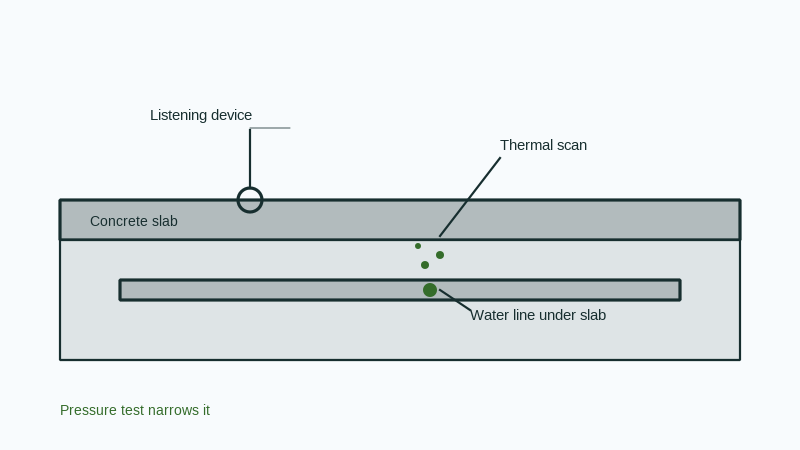
When a supply pipe cracks inside or under the concrete foundation of a house, the result is a slab leak. Since nobody can see it, the order of work never changes: confirm the leak is real, pin down the exact spot, pick a repair method, then restore the floor. Skip the pinpointing and you could end up with a torn-up hallway while water keeps escaping. This guide walks through each stage for Simi Valley and Moorpark homes, and the Arroyo Simi Plumbing home page links to our other plumbing guides. To get a quote, submit a request. We forward your details to a local plumbing business, and the business that accepts requests like yours pays us a fee.
What are the signs of a slab leak?
Watch for a floor that feels warm, running water you can hear with every tap closed, a bill that suddenly climbs, wet or lifting flooring, weak pressure, and a meter dial that will not stop spinning. A single symptom could have another cause, but two or three together strongly suggest a leak beneath the slab.
Walk barefoot across tile or concrete, since a warm patch hints at a leaking hot line. Listen along walls and floors at night. Then check the meter: EPA advises noting the dial, keeping every tap and appliance off for two hours, then reading it a second time; any movement points to a probable leak. If the bill rises while your habits stay constant, read why your water bill may be high.
Which methods locate a slab leak?
A plumber combines several techniques. Sections of line get pressure-tested to see which one holds, ground microphones pick up sound, thermal imaging scans for warm spots, and a small camera or tracer gas is sometimes added. Each one shrinks the search area, and using two or more together gives the best results.
Pressure testing shows which line is leaking, hot or cold, and on which branch. Acoustic listening picks up the hiss of escaping water, which is loudest at the leak. Thermal imaging works well for hot-line leaks. Detection is a craft: concrete, rebar and soil can all hide or distort a signal. Before anyone cuts, ask which tools are planned and whether the leak gets marked on the floor. For what that step costs, see leak detection cost.
How can a slab leak be repaired?
Three main routes exist: open the slab and mend the pipe at the break, retire the leaking line and install a new one overhead or inside the walls, or coat the old pipe from the inside. They differ in mess, price and lifespan, and the best pick depends on how worn the pipe is and how many leaks it has had.
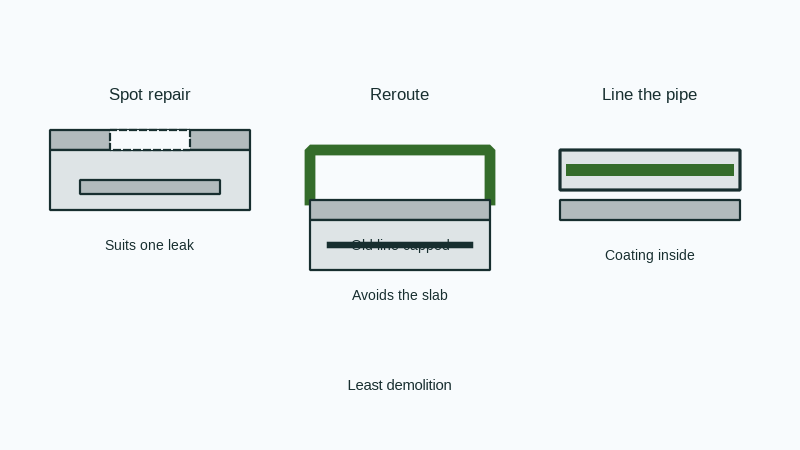
A spot repair is direct and fits a single leak in an easy-to-reach area. Rerouting bypasses the slab and fits a pipe with repeated leaks. Lining seals the pipe interior with a coating and needs less demolition, but it hinges on the pipe and its fittings being in suitable shape. If you are torn between patching and replacing the lines, compare the two in spot repair versus a full repipe.
Why are slab leaks common in Simi Valley and Moorpark houses?
Plenty of homes from the 1960s through the 1990s rest on concrete slabs, and in some of them the water lines pass through or under the concrete. After decades, pipes can corrode, chafe against gravel or concrete, or give way at joints. Local water chemistry and soil can speed that up.
Your water supplier publishes a yearly quality report with hardness and chemistry figures. Most of Simi Valley is on Ventura County Waterworks District No. 8, the eastern end on Golden State Water, and Moorpark on District No. 1. Copper beneath slabs is a known weak point in some regions, and a pinhole leak is often the first symptom. That symptom is introduced in the page on a pinhole leak in copper tubing.
What happens during a slab leak repair?
The plumber begins by closing the water and covering the floor, then drills or cuts at the marked spot, exposes the pipe, repairs or swaps that section, tests it under pressure, and fills the opening with concrete. A reroute instead puts new lines overhead and caps the old one. Flooring, trim and paint come last, often handled by another trade.
Expect noise, dust and part of a day with no water. Ask whether the plumber tests before closing the hole, who handles the permit, and who restores the flooring. A reroute or line replacement typically needs a permit as well as an inspection. In Simi Valley, the City's Building and Safety Division issues permits, while Moorpark has its own Building and Safety office.
Does slab leak work require a contractor license?
Generally yes. In California a contractor license is required when a job's labor and materials reach $1,000, and for any job that needs a permit whatever it is worth. Slab leak repair often exceeds that amount. Look up the license number on the state licensing board site and confirm the name matches your quote.
Ask about the deposit as well: the state caps it at whichever is less, $1,000 or 10 percent of the contract price. Have the scope written down, covering detection, repair method, permit, floor restoration and what happens if a second leak shows up. More questions to bring are on our page about picking a slab leak repair company.
What should I do first?
If water is visible or audible, close the main water shutoff, clear belongings from its path, take dated photos and report any damage to your insurer. Avoid running water-using appliances. If you smell gas, leave the building and contact your gas utility from outside (SoCalGas where gas runs down your street), and use 911 if anyone is at risk.
Policies differ, so read up on burst pipe coverage under home insurance and note the terms that apply to you. Requests through the form are read Monday to Friday, 9am to 5pm, so shut off the water first and send yours afterward. EPA figures put the yearly loss for an average household at more than 9,300 gallons of leaked water, which is why even a slow slab leak needs fast action.
Common questions
Will a slab leak seal on its own?
Never for good. Pressurized water keeps escaping, and the damage spreads through soil, concrete and flooring. Soil can pack around a leak and make it seem to slow for a while, but it returns. Shutting the water at the main stops the harm until a plumber finds and repairs the break.
How long does it take to find a slab leak?
It is usually a short visit, though complicated houses take longer. The plumber pressure-tests lines, listens, and marks the probable spot. Hidden or multiple leaks add time. Get the plan in writing, including what happens when the first reading is unclear and whether the detection fee is credited toward repairs if you proceed.
Is slab leak detection accurate?
With good equipment and a careful plumber, most leaks are found within a small area, but concrete, rebar and soil can skew readings. That is why plumbers combine methods and verify before cutting. Find out what confirms the leak and whether the spot is marked where you can see it.
Will slab leak repair damage my floors?
Spot repairs cut into the floor at the leak, so tile, wood or carpet there is affected. Rerouting spares the slab but opens walls or ceilings. Ask which flooring gets restored and whether a match is possible, since older tile may be discontinued. Have the answer in the quote.