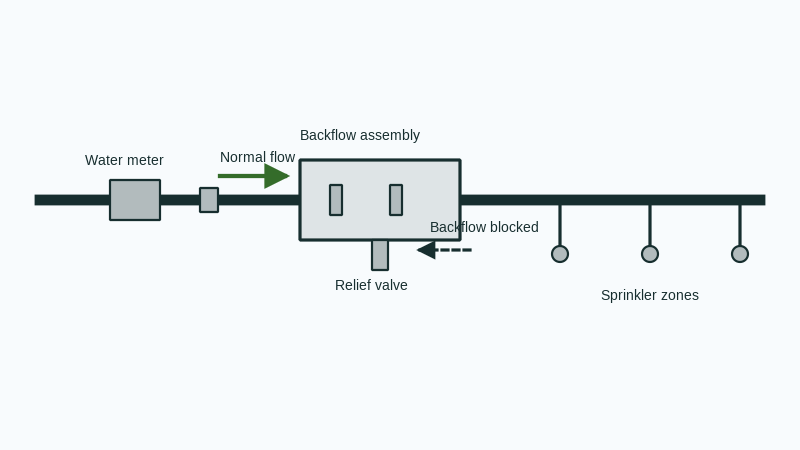
During a backflow test, a trained tester connects a gauge kit to your backflow assembly, works its valves in a fixed order, and records whether the check valves hold. Homeowners do not perform this. If your water provider has requested a test, a local plumbing business with a tester can handle it, and our home page explains how to request one.
What is a backflow test checking?
What gets verified is whether the relief valve and the check valves within a backflow assembly seal properly. These parts exist so that water, once beyond them in a sprinkler system, fire line or commercial equipment, cannot reverse and be drawn back into the public supply.
Backflow occurs when pressure in the street main drops, for instance during a main break or heavy fire-hose use, and the water in your pipes runs the wrong way. The assembly acts as a one-way gate. Rubber seats wear, springs weaken and grit lodges on the seat, so the gate has to be exercised and measured on a schedule instead of assumed.
Which properties must have a test?
Those with a cross-connection hazard: lawn irrigation, a dedicated fire line, a pool fill, a commercial kitchen or a medical or industrial process. Many ordinary houses with irrigation have an assembly on the sprinkler line. A house with no irrigation and no special connection often has nothing to test.
Your water provider makes the call, not us. Ventura County Waterworks District No. 8 serves most of Simi Valley, and Golden State Water the eastern end. Ventura County Waterworks District No. 1 serves Moorpark, not the City. Calleguas Municipal Water District supplies all of them wholesale. A notice that came with your bill is from your retail provider and gives the deadline.
How does the tester work through the assembly?
The tester shuts the downstream valve, attaches a differential pressure gauge to the test cocks, then opens and closes the cocks in turn to read the pressure loss across each check valve. Each reading must reach a minimum. The tester also confirms that the relief valve opens at the proper pressure, then restores service.
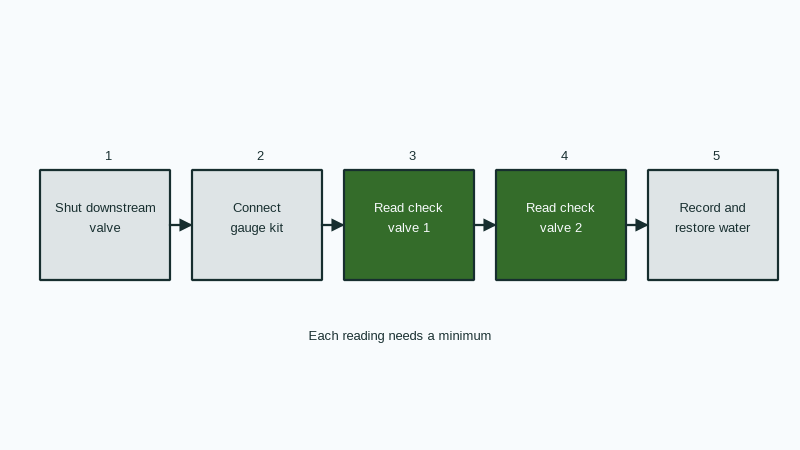
In plain order: tell you the supply will be off for a short time; close valve 2; connect hoses; bleed air; read check valve 1; read check valve 2; test the relief valve if the assembly has one; reopen valves; record the numbers. Reduced pressure assemblies, double check assemblies and pressure vacuum breakers are tested slightly differently, and the tester uses the method that fits yours.
A pass produces a form with the readings, the assembly serial number and the tester's details, which goes to the provider. A fail leads to a repair, usually new rubber seats and springs from a rebuild kit, and then a retest.
Who is permitted to do the test?
Only a tester whose backflow qualification your water provider recognizes, and the provider often keeps its own list of accepted testers. The tester qualification is separate from a contractor license, and many plumbing businesses employ someone who has it. You should not test your own assembly and send in the numbers.
Ask the provider whether it takes tests from any qualified tester, or only from names on its list. Then, when you request quotes, ask the plumber for the tester's qualification details. California contractor rules still cover the repair portion of the work, and the state licensing board's website lets you verify a contractor license.
How often is a test needed, and what is my role?
Providers usually require a test when an assembly is installed, after repair or relocation, and then once a year. Check the schedule with your own provider, because rules differ between water districts and by hazard level. Your part is small: keep access to the device clear and make sure someone can answer the door.
Before the visit, trim back plants around the assembly, remove any box or cover that is stuck, and know where your shutoff valves are. Water will be off to the line being tested, so irrigation stops for a short while. A plain test with no repair takes a short visit in most cases. A rebuild can add more time and parts.
What happens if the test fails?
Either the worn parts or the whole assembly get replaced by the plumber, who then retests it and files the result with the provider. Rebuild kits cost less than a new assembly, but an older, corroded body is sometimes replaced outright. Ask which the quote assumes.
Swapping the whole assembly can mean cutting into supply or irrigation pipe, so it is plumbing work for a contractor, and an installation may need a permit. Your city office decides. In Simi Valley the permit goes to the Building and Safety Division, and in Moorpark to the Building and Safety office; both are listed on the city website. Check with the office before assuming.
An assembly installed above grade in a visible cage near the sidewalk should be checked for freeze damage, cracks or landscaping covering it. These turn up often on a visual check and are worth mentioning when you request a visit.
On the price side, see plumber inspection cost. For a regular visit, backflow prevention testing and backflow testing services cover booking.
Common questions
May I test my backflow preventer myself?
No. A test needs a calibrated gauge kit and a tester whose qualification the provider recognizes, and your water provider will usually only accept results from such a tester. You can help by clearing access to the assembly and noting any leaks or drips you have seen from its relief port.
How long does a test normally take?
A routine test with no problems is generally a short visit, and part of it has the line's water turned off. If the assembly fails and requires a rebuild, allow longer. Once the tester has seen the make and model of your device they can give a better estimate.
What do I ask a business before they test?
Ask if the tester holds a current qualification and if your provider accepts that tester, what the price of the visit covers, who files the report, what a repair would cost per part, and if the business will retest after a repair. Written answers are best.
Is the water shut off for the entire house?
Usually only to the line the assembly protects, such as the sprinkler system. If the assembly sits on the main house line, which happens with a dedicated fire line or at a commercial site, the tester will say so in advance and may schedule it for a quiet time.